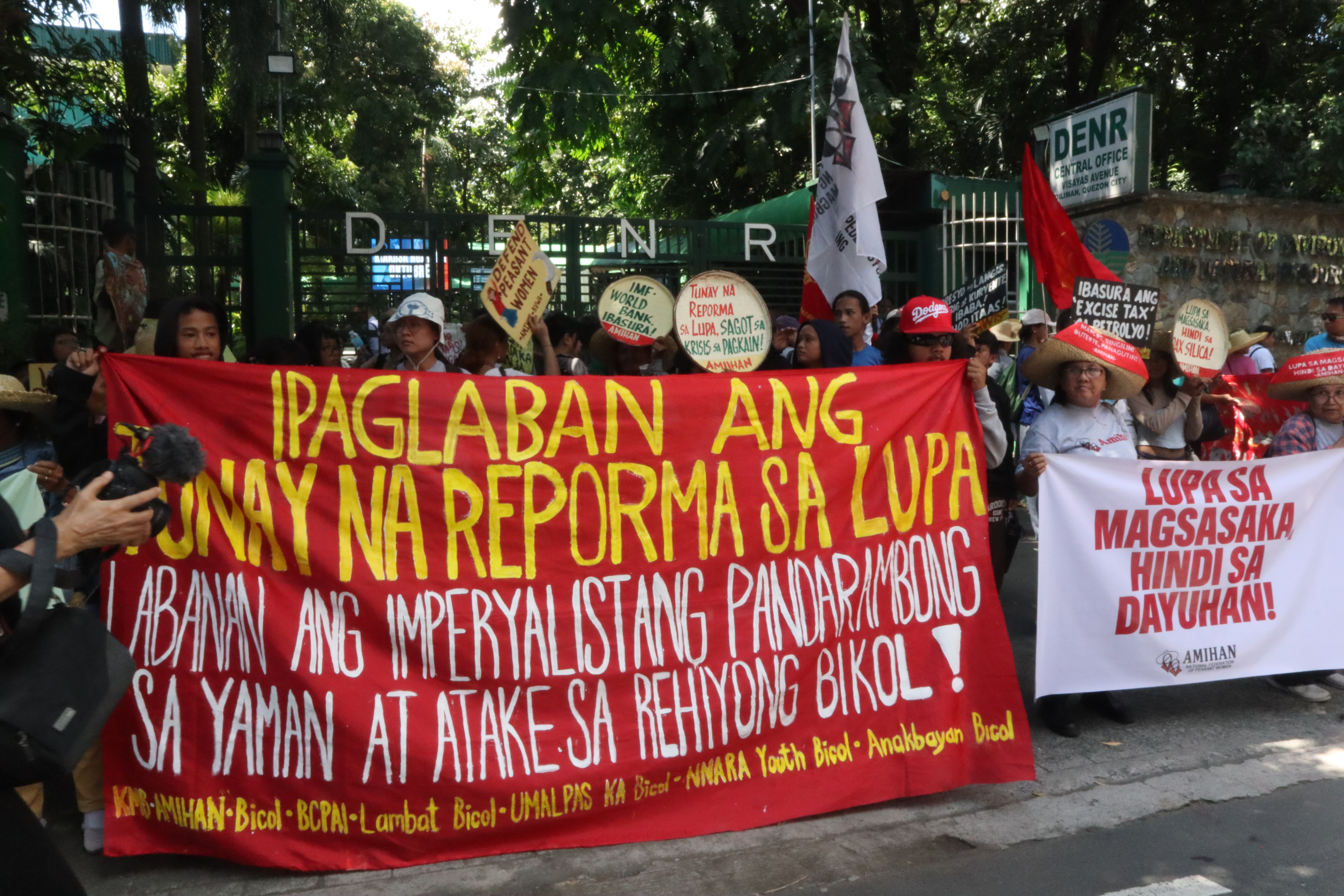
Bicolano farmers and fisherfolk joined agricultural workers from other regions in rebuilding their protest camp at the Department of Agrarian Reform (DAR) central office in Quezon City on 19 October, following an earlier police intervention at their campsite, as they pressed the government for immediate assistance over agricultural losses caused by the El Niño crisis.
Kilusang Magbubukid ng Bicol (KMB) and Bagong Alyansang Makabayan (Bayan) Bicol reported that the Quezon City Police District (QCPD) ordered protesters to clear their camp in front of the Department of Environment and Natural Resources (DENR) on the night of 16 October.
The groups alleged that QCPD PLTCOL Bryan Angelo Pajarillo demanded that the camp be cleared by 8:00 p.m., with police having a long-range acoustic device (LRAD) on standby to disperse protesters.
The farmers began their week-long camp-out on 15 October, with the mobilization scheduled to run until 21 October. According to KMB, they later rebuilt their makeshift shelters at the DAR central office, joined by farmers from other regions, peasant advocates, and other sectors. The camp-out sought immediate and sustained government assistance for rural communities grappling with drought, dwindling water supplies, declining harvests, and rising agricultural production costs.
The group said protesters continued their mobilization despite what it described as violence and intimidation by the Philippine National Police (PNP) and its Special Weapons and Tactics (SWAT) team.
The renewed encampment along Elliptical Road was met with another police intervention on 19 October, when personnel attempted to dismantle temporary shelters erected by protesters. Several farmers and youth advocates were reportedly injured during the confrontation. Police, meanwhile, maintained that the construction of temporary shelters outside the DAR lacked the necessary authorization from the local government.
Mounting agricultural losses
Drought caused an estimated ₱157 million in agricultural losses in Bicol from June to September 2026, affecting 4,719 farmers and 3,802 hectares of farmland, with 4,297 metric tons of crops lost, KMB said, citing the Department of Agriculture (DA).
KMB also reported that palay production costs range from ₱60,000 to ₱100,000 per hectare, while farm-gate prices have fallen to as low as ₱17 per kilogram. Fertilizer costs up to ₱3,000 per bag, while copra farmers earn only ₱15 to ₱18 per kilogram before resikada deductions.
The group further estimated that 66 percent of farmers in the region had not received government assistance.
“In several farming communities, water shortages have prevented planting and reduced harvests, while rising fuel and farm input costs further erode farmers’ incomes,” said Regina Barbacena, KMB spokesperson.
During consultations on 15 October, farmer and fisherfolk organizations documented the effects of the crisis on rice, coconut, abaca, banana, and vegetable production across Albay, Sorsogon, and Camarines Sur, according to KMB.
In Sorsogon, farmers reported water shortages affecting rice production in Castilla, Donsol, Matnog, Gubat, Bulan, Bacon, and Santa Magdalena, ad the Bacon district of Sorsogon City. They also reported smaller coconut yields and dying abaca plants.
In Guinobatan, Albay, a coconut farmer reportedly earns around ₱4,000 monthly, while irrigation water no longer reached some neighboring rice-growing communities. Farmers in Camarines Sur, meanwhile, face production costs of approximately ₱20,000 per cropping cycle and higher irrigation fees during the dry season.
According to Lambat Bicol, a large fishing boat in Pio Duran, Albay, spent approximately ₱2,500 on fuel per night, with total operating expenses reading ₱3,500. Catches of tamban can fall from as many as 20 banyera during peak season to about four kilograms outside it.
Farmers demand direct assistance
Barbacena urged the DA to provide direct, non-loan assistance to farmers and agricultural workers, including those without land titles or excluded from existing assistance programs because of their land-tenure arrangements.
Roel Llamera of Samahan ng Magsasaka sa Sorsogon (SAMASOR) called for the rehabilitation of existing irrigation systems, communal water pumps, alongside subsidies for fuel and irrigation expenses. Fisherman Fernando Ferer, likewise, appealed for immediate fuel assistance and livelihood support for municipal fisherfolk in Pio Duran.
Kilusang Magbubukid ng Pilipinas (KMP) also demanded free irrigation, affordable fertilizer and fuel, fair palay prices, and genuine agrarian reform.
“Short-term aid and haphazard solutions are not enough,” said KMP chairperson Ronnie Manalo.
Camp rebuilt, protest continues
Despite the police interventions, KMB and Bayan Bicol maintained their opposition to what they described as intimidation and coercion, holding the Marcos Jr. administration accountable for the treatment of protesting farmers.
“If the DENR thinks that our struggle will end there and will be stopped by the LRAD, the Bicolano farmers will not be silenced,” Barbacena said.
Jen Nagrampa, Bayan Bicol chairperson, said the camp-out would further expose the administration’s failure to prepare for the impacts of what she called a “Super El Niño.”
On 21 October, KMB announced that it would join other progressive groups in farmer-led anti-corruption protests in Metro Manila, maintaining its calls for agricultural assistance and accountability over the government's response to the crisis.
Local activities were also planned in Bicol, including simultaneous El Niño and Pax Silica forums in the coastal community of Calabanga, Camarines Sur, and at the Albay Farmers Bounty Village in Camalig, Albay.