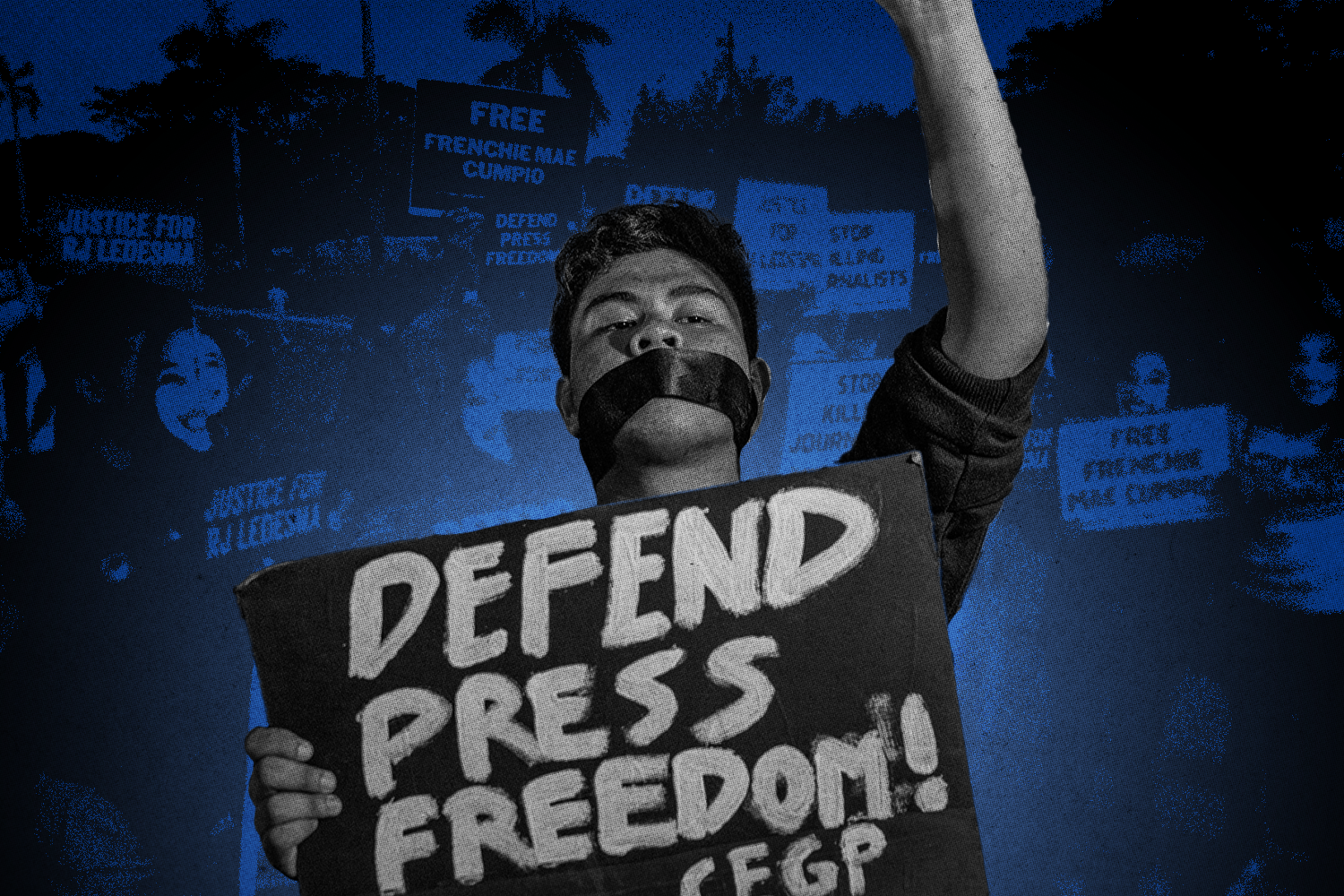
Today, 30 August, we celebrate National Press Freedom Day, a reminder that the freedom to speak truth to power is not a privilege, rather, a right that must be protected, especially when exercising it becomes inconvenient. Yet, in a country where we celebrate the free press as often as the sun rises, it is not a distant doubt that we are not free.
Yearly, the Philippines observes two specific legally recognized press freedom days, alongside globally recognized observances—today marks the third observance after the World Press Freedom Day last 3rd of May, and Campus Press Freedom Day last 25th of July. Beyond these dates, publications fire up their pens to write stories that not only shatter silence, but also amplify the voices of the vulnerable through journalism. However, there is still a very heavy cloak that covers the truth and continues to censor the media through threats, harassment, and red-tagging.
Three observances. Three chances a year for the country to put out a statement, hang a tarpaulin, and call it done. But a day named after a freedom does not manufacture that freedom. It only measures the distance between what we celebrate and what we actually have. And the distance, when you look closely, is measured in bodies, in court dockets, in dead air on a television screen, and in the fear over a newsroom after a knock on the wrong door.
The Danger in Truth
The press exists not merely to tell us what happened, but to ask why it happened, who is responsible, who is affected, and what happens next. Yet asking these questions becomes difficult when the journalist asking them can become the target.
In the Philippines, red-tagging remains one of the ways journalists are threatened. Instead of confronting what a journalist reports, the person behind the report is attacked, labeled, and made to appear dangerous. A journalist can suddenly find themselves being called a communist, a terrorist, or an enemy simply for covering issues that powerful people would rather leave unquestioned.
The case of journalist Frenchie Mae Cumpio shows how far these attacks can go. Arrested in 2020, Cumpio spent years in detention before being convicted in January 2026 of financing terrorism and sentenced to 12 to 18 years in prison. Several media freedom organizations have raised serious concerns about the case, particularly because of the red-tagging, surveillance, and harassment she had experienced in connection with her work. Cumpio and her supporters have maintained that the accusations against her were fabricated.
For a journalist, that is not just a debate about press freedom, but is a question of whether doing the job can put your life and freedom at risk.
Kapag Namatay ang Signal: The Shutdown of ABS-CBN
In May 2020, ABS-CBN was ordered off the air after the National Telecommunications Commission issued a cease-and-desist order following the expiration of its congressional franchise. The shutdown removed one of the country's largest news organizations from television and became a major issue in discussions about press freedom and the public's right to information.
Whatever one's political position on ABS-CBN may be, the shutdown showed how vulnerable media organizations can become when their ability to operate is placed in the hands of institutions with political power.
A journalist can finish a story and be ready to report it. But if the platform is silenced, the public never gets to hear it.
And that is why censorship should concern us even when no newspaper is physically taken away and no journalist is explicitly ordered to stop writing. Sometimes, silence is created by simply making it harder for the truth to reach the people.
Journalism Costs Lives
Then there are journalists who never got to return to their newsrooms.
On 23 November 2009, 58 people were killed in the Ampatuan Massacre in Maguindanao. Thirty-two of them were journalists and media workers who were accompanying a convoy covering the filing of a political candidacy. It remains the deadliest single attack on the press recorded by the Committee to Protect Journalists.
Thirty-two journalists.
It is easy to read the number and move on.
But each of those 32 was a person with a family, colleagues, unfinished work, and a life outside the newsroom. They went out to cover a political event and never came home.That is the part of press freedom we sometimes forget when we reduce it to a principle written in the Constitution. For some journalists, the danger of doing the job is not losing a platform or receiving criticism. It is not making it home.
The Ampatuan Massacre is a stark reminder that press freedom cannot exist meaningfully without the safety of the people who exercise it. A journalist may have the legal right to report, but what does that right mean when reporting can make someone a target?
Freedom Does Not Mean Irresponsibility
Still, defending press freedom does not mean defending every piece of journalism. Journalists can be wrong, and publications can make mistakes. When that happens, journalists should be held accountable. Freedom does not mean freedom from accountability; it means having the space to pursue truth while upholding accuracy, fairness, ethics, and the dignity of the people whose stories we tell.
Accountability should correct journalism, not silence it. It must challenge power, but it must also challenge itself.
Bilang Isang Mamamahayag
Journalism was not an automatic choice because of its safety net. None of us did. But there is a particular kind of dread in your chest the first time you read about a colleague, a fellow campus writer, receiving a threat for a story you would have written the same way. It is not the dread of “that could be me.” It is the dread of realizing it already is.
Press freedom in this country is not being taken from us in one dramatic seizure; it is being worn down, incident by incident, until self-censorship becomes innate.
For campus journalists, these realities may seem far from our own newsrooms. But they are not. We write about student welfare, education, governance, injustice, culture, and the society we are preparing to inherit. The issues may begin inside the campus, but they do not stop at the campus gates.
What this really implies is that we have confused observance with liberation. We have let the existence of a day named “Press Freedom” stand in for freedom itself, the way a certificate on a wall can stand in for a skill someone never actually learned.
You can hold a commemoration every year for the rights of people who cannot safely exercise them. The two are not contradictions. In this country, they have learned to coexist.
So, What Are We Celebrating?
This is what makes National Press Freedom Day difficult to celebrate without also questioning what it means. We have World Press Freedom Day, National Campus Press Freedom Day, and National Press Freedom Day.
Three occasions reminding us of a freedom that, in practice, remains fragile.
We celebrate the press while journalists continue to face red-tagging, harassment, threats, censorship, and violence. We honor those who speak truth to power while some are still made to pay a price for doing exactly that.
Perhaps this day serves to be a reminder that the work is far from finished.
Because when the press is silenced, it is not only journalists who lose their voices. The public loses its eyes and ears. And when people can no longer question, investigate, criticize, or demand answers, democracy becomes vulnerable to the very silence that allows abuse of power to flourish.
A free press is not an enemy of democracy. It is one of the things that keeps democracy alive.
And if we continue to celebrate press freedom while journalists and campus journalists remain vulnerable to censorship, intimidation, red-tagging, and threats, then perhaps the celebration itself should make us uncomfortable.
Three observances a year will never add up to a free press if journalists still have to calculate, every single time, how much truth they can afford to tell.
Ang totoong kalayaan ay hindi binibilang sa petsa. Nararamdaman ito, o wala talaga.