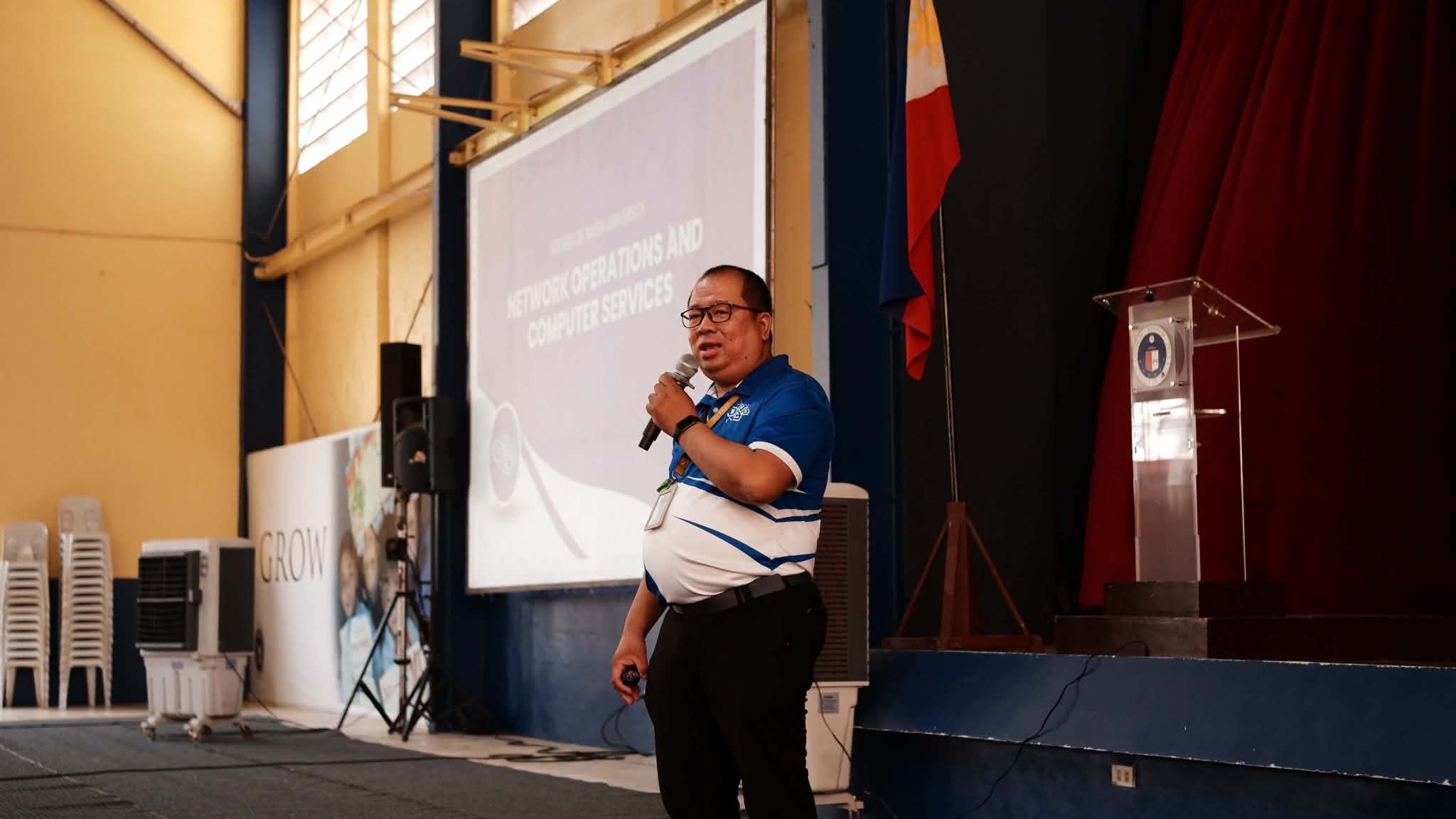
Student concerns over campus connectivity, digital services, and security took center stage during Concord, a campus conversation spearheaded by the university’s Marketing and Communications Office (MARCO) and held at the Ateneo de Naga University Gymnasium on 1 September 2026.
Representatives from the Network Operations and Computer Services (NOCS), Management Information Systems (MIS), and Campus Services and Operations Office (CSOO) were present to provide information and respond to concerns raised during the event.
UniFi and campus connectivity
Among the concerns raised during the event was the university’s ongoing transition to a UniFi-based wireless network.
Engr. Zero Magellon, director of Network Operations and Computer Services (NOCS), reported that the university’s bandwidth has increased in recent months, rising from 1 Gbps to 2 Gbps and eventually to 4 Gbps. Magellon also outlined a four-year plan to further expand connectivity, with the goal of providing full coverage across the Bagumbayan Campus by 2030.
As part of the upgrade, the university has shifted to a UniFi-based wireless network infrastructure, with UniFi U7 Pro and UniFi E7 Campus access points installed across the campus. Magellon reported that a total of 127 access points are currently in place as part of the network infrastructure upgrade, replacing the previous RADIUS-based Wi-Fi authentication system.
Despite the expansion, students continued to raise concerns about connectivity. NOCS acknowledged ongoing issues involving the UniFi system and said it continues to monitor and troubleshoot connectivity across the campus.
As an immediate measure, the office said Wi-Fi access would be provided without a password while the issue is being addressed.
AdNU AURA
The discussion also introduced AdNU AURA, presented by Polo Silvestre, project head of Access to University Resource and Assistance (AURA).
Silvestre said the project aims to provide students with a mobile companion designed to simplify the Ateneo experience by bringing campus services, resources, and university communication together in one platform.
Currently, the app features university events, real-time notifications for urgent updates such as class suspensions, and a mobile news feed containing official university events and articles.
AURA is also set to expand its features, with planned offerings including iOS compatibility, a virtual campus map, Contact Us and About Us sections, a smart campus directory, Ask AdNU, and AdNU Care.
The planned features are expected to provide students with additional access to campus information, services, and assistance through a single platform.
Campus safety protocols
The final session of the campus safety and security discussion focused on the shared responsibility of creating a school environment where students, faculty, and guests can feel safe, secure, and welcome.
James Michael Reyes, Occupational Health and Safety Officer of the Bagumbayan Campus, outlined the security measures currently being implemented across the campus, emphasizing that safety begins at the gates.
Students entering the campus are required to wear their identification cards, while visitors must present valid identification. Vehicles are subject to inspection and must have green card stickers before entering campus. Bag inspections, vehicle checks, and dress code inspections are also mandatory, with students encouraged to avoid bringing unnecessary items to school.
At present, only one walkthrough scanner is available at the main gate. Reyes said the university is looking into providing additional scanners at all three campus gates, as well as at the Senior High School building.
Security personnel have also been added at key entry points. Two personnel are assigned to the main gate, while one is stationed at the Sta. Cruz Gate, another at the Queborac Gate, and one at the Senior High School building. An emergency vehicle is likewise available on campus for urgent situations.
The university has also expanded its surveillance system, with CCTV cameras now covering approximately 80 percent of the campus. Reyes clarified that the cameras remain operational during power outages.
Beyond physical security measures, Reyes discussed emergency procedures students should follow during critical incidents.
In the event of an earthquake, students were reminded to follow the “Duck, Cover, and Hold” procedure and avoid using elevators. For an active-shooter situation, Reyes advised students to move away from the threat, secure their location by locking and barricading doors, and silence their phones. He said fighting back or defending oneself should only be considered as a last resort.
Students were also urged to report incidents immediately and follow announcements, instructions, and advisories issued by campus security and authorities. They were reminded not to return to an emergency area or spread misinformation and rumors while an incident is ongoing.
To strengthen preparedness, Reyes said the university intends to conduct a security awareness seminar in coordination with the Office of Student Affairs (OSA). The seminar will focus on what students should do before, during, and after emergencies. Security contact information was also shared for use during emergency situations.
Students also raised concerns about areas requiring further attention.
Attendees called for additional lighting in darker areas around the campus. Reyes said the installation of additional lights would be addressed as soon as possible, while solar-powered lights would also be considered.
Questions were likewise raised regarding the university’s definition of “sharp objects,” including whether items such as scissors and box cutters commonly used for school activities are covered by the policy and how the metal-detection process identifies such objects.
Officials also announced that another session will be conducted to further discuss campus dress code policies, extending the conversation on safety, discipline, and student welfare.