EDJOP: The Making of an Ordinary Rebel
Some stories remain relevant because the questions they raise do not belong to one timeline; it bleeds forever.
For a generation growing up in a different political and social landscape, the distance between then and now may seem wide—but the wounds that tie up courage, dissent, and collective action together remain familiar. On 16 September 2026, Ateneo de Naga University was the final stop of EDJOP's campus conversation tour. The campus conversation was not just an advertising tactic for students, nor a live-action poster screaming "Come, watch our movie!" Instead, it bangs with a message so strong, it left us up at night with one question: What does it mean for a young person to care enough to act?
Why Edjop, Why Now?
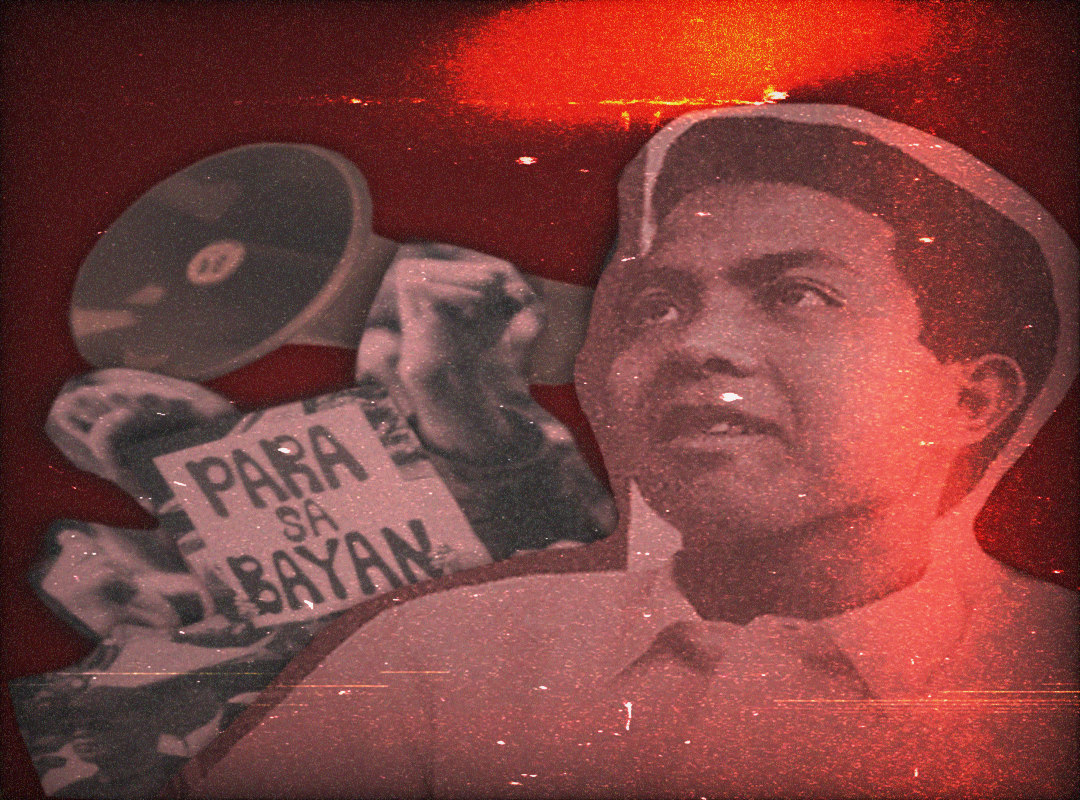
Directed by Katski Flores, EDJOP follows the life of Edgar Jopson, a prominent student leader who eventually turned away from a life of privilege to confront the Marcos dictatorship. Before he went down to history, Jopson, known as “Edjop,” was just another Atenista. He was the president of the National Union of Students of the Philippines (NUSP), the, then, largest student formation with members coming from 69 schools across the country. He led 27,000 students to rally for the rights of the Filipino people, with a high aperture on the Filipino workforce. However, the Philippines under the regime of Marcos Sr. gave him little room to stay a student for long. When martial law tightened its grip in 1972, Edjop went underground, until his life ended in a firefight in Davao in 1982—one more name among thousands lost to a dictatorship.
He was someone’s child, a friend, and a family, but when the bullets hit him—his story was cut short, and all of a sudden, he can no longer witness the future he has been planning for a long time.
That history is precisely why EDJOP’s campus conversation tries to place itself in front of the new generation. According to the scriptwriter of EDJOP, Jade Castro, if Edjop was still alive today, he would say to the students “Tapangan niyo.”
This single line is more than enough to keep the ignited heart of student activists burning, a testament that courage will lead you to places, and maybe, make the country a little better than ever.
EDJOP does not dwell on the biography for its own sake. It uses Edjop’s experience as a mirror. He was once exactly where the students sitting were—eager, unsure, and still forming his own politics. The film resists the temptation to skip straight to being the scapegoat. Instead, it lingers on the version of him that had not decided anything yet—it shows that he was, like us, human.
Bringing EDJOP to the screen
Bringing Edjop’ story and experience to the film meant confronting the political tensions that shaped his life, most especially today, as the country faces a direct descendant of the same dictator he once fought against. One line in the film captures that tension, “We shall realize with a sense of shock, that they no longer wish to parley or to talk, just to fight.”
Indeed, what will the people do when the sole peaceful solution we wish to deliver to the abuser through diplomacy and dialogues, no longer works? And for a crowd without guns and swords, this leaves us without any backdoors; we ultimately surrender to dictatorship.
Rather than treating the past as a fixed chapter in history, the film uses moments like this to place audiences within the uncertainty of the period, and to show how a young person’s understanding of society can change when dialogue begins to break down.
Behind the film that now brings Edjop’s story to campus is five years worth of research, countless drafts to be submitted, and production. What eventually reached the screen was not built overnight.
For screenwriters Jade Castro and Katski Flores, the writing process came with its own hurdles. They experienced infinite problems, thinking they would no longer be able to produce this film. But because of their perseverance and love for the craft, they were able to overcome it.
The team also carried uncertainty throughout the production of the film. “Noong una talaga natakot kami, in making the film but how we will eventually receive it from the government as represented by MTRCB.” director Katski Flores shared. This concern reflected one of the realities that Filipino filmmakers had to cope with while bringing a story rooted in a politically significant period in the Philippines to the screens.
The preparation also extended beyond the script and production set. Ms. Jodi Sta. Maria, who portrays Joyette Jopson, child of Edjop, underwent triathlon training for the role, adding another layer of physical preparation to her performance.
Why do they do this?
For the film's director and scriptwriter, bringing EDJOP to different students, universities, and schools was never just about a promotional tour. They were always asked why they make the time to actually converse with the students through EDJOP. Katski Flores answered it;
“Kaya kami actually, umiikot sa mga campuses since nag-umpisa buhay niya (Edjop) bilang isang Atenista, bilang isang estudyante. Yung panahon ng kabataan, yung coming into your awakening as a young adult. Yung space between 16-25, those are the years where we feel where we are our most pure, where we are most idealistic, where we are most flourish kasi marami pa tayong pinaniniwalaan, andami pa nating pag-asa.”
Decades may separate Edjop from the students today, but the stage of life remains familiar: sitting in the classroom, forming convictions, questioning the world, and deciding what kind of person one wants to become. In a sense, the campus conversation did not only bring together students to talk about the film EDJOP, it also became a space and an opportunity for the students to examine their own years of awakening and what they choose to do with them.
A question, not an answer
What made the campus conversation worth sitting through was not a tidy resolution. Whether students today should be activists in the way Edjop was moving over the discussion without ever being answered outright, and maybe that was the point. The film was not an adaptation of his life. His underground networks, his rallies, the particular shape his courage took under the regime of Marcos Sr.—those belonged to his moment. What the movie kept circling instead was something harder to imitate and harder to dodge: noticing what troubles you, and refusing to let that discomfort quietly pass.
It was Katski Flores who put words to what that might look like for the students today. “Habang nasa institusyon pa kayo, gaya ng Ateneo, ang dali at ang sarap ‘akapin yung belief na pwede pa tayo magbago at may kaya akong gawin. Mayroon pang pag-asa sa pagbabago.” Director Katski Flores said, a reminder that the hope Edjop once held onto as a student is, in some ways, easier to access here than it will ever be again.
Maybe that is the answer EDJOP is actually looking for—not a statement, but an attention that stays like the burn of light into one's eyes. Activism can begin, starting from an observation, a question that remains unanswered, a refusal to accept what feels wrong, or the decision to speak up even though staying silent is easier. It can take different forms across different generations, but at its core is the same choice, is it to remain a bystander or to become part of the action?