
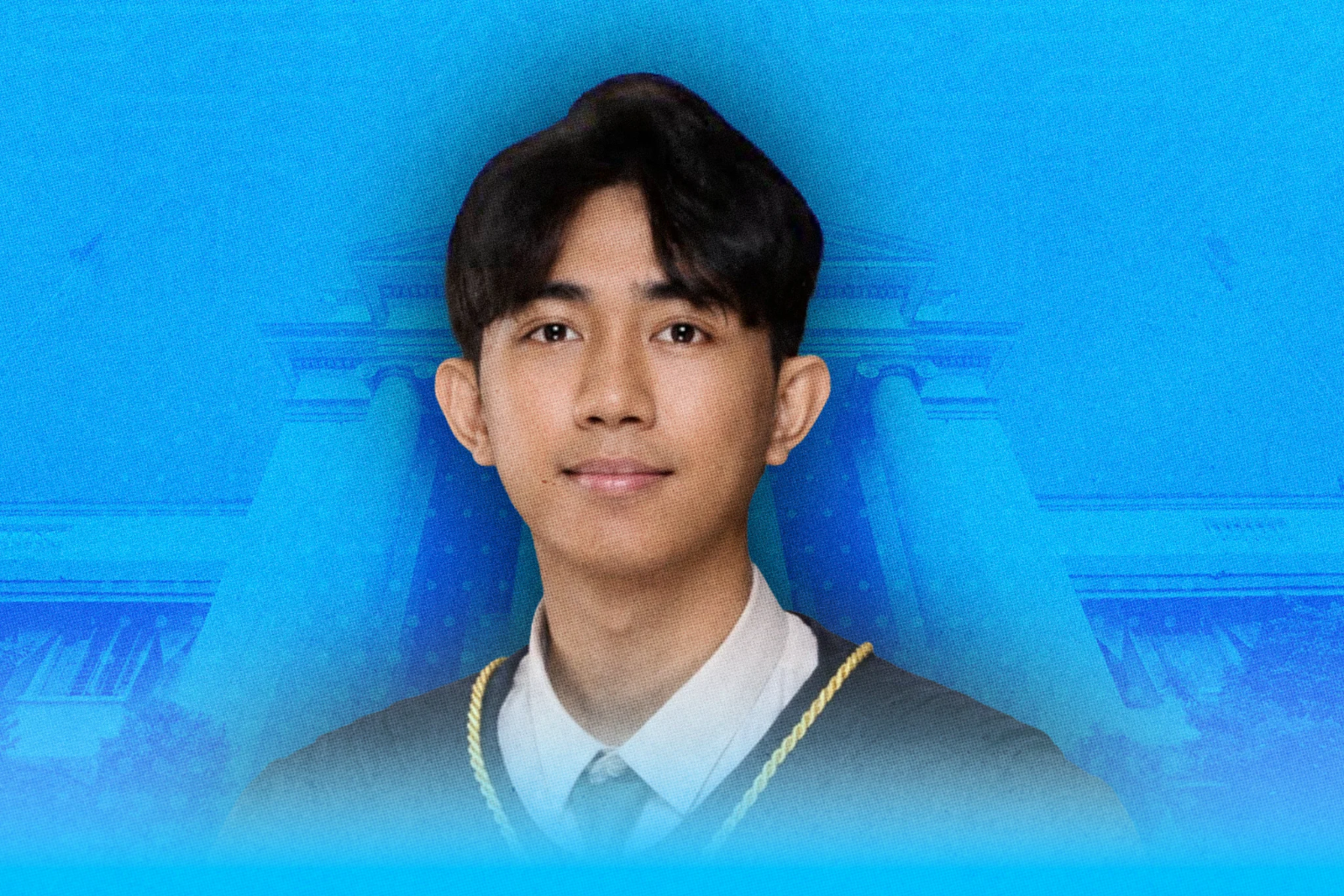
With five minutes left on the clock, Francis Marcelino Peña was still on item 70.
The Mathematics portion of the Electronics Engineer board exam had slipped away from him. He had mismanaged his time, and now he was racing through the remaining questions, shading answer after answer with a hand that had no room to doubt. He finished at the last second. There was no time to check his work, and the fear that came with it was specific and heavy: a double-shaded answer, he knew, is treated as cheating, and cheating can mean a permanent ban from future PRC examinations.
He walked out of that room hoping only to pass. He had already, by his own account, let go of the idea of topping the exam.
On 23 October 2026, he learned he had placed eighth in the nation.
“Sometimes, dreams don’t really disappear when we give up on them. They stay with us, quietly waiting for us to find the courage to pursue them again.”
The Person Behind the Rank
Asked to describe himself without leaning on his academic record, Francis does not reach for the usual adjectives of the high achiever. He does not say brilliant, or driven, or gifted. He says persistent and passionate.
Then he explains what those words cost him.
There were stretches of his journey, he admits, when things became so overwhelming that he broke down and began questioning himself. There were failures and setbacks. And yet, through all of it, he says he never lost sight of becoming an Electronics Engineer.
“What defines me most isn’t necessarily how well I handle success, but how I respond when things don’t go my way.”
It is an unusual thing for a Top 8 examinee to say, and a revealing one. His story is not built on a flawless record. It is built on a pattern: he struggles, gets lost, sometimes breaks, and then finds a reason to stand up and face forward again.
Now a licensed Electronics Engineer and Electronics Technician, he says he is proud, “not just of what I’ve achieved, but also of the person I’ve become along the way.”
A Year Behind, and in a Hurry
The usual path for a fresh ECE graduate is to wait for the April board examination of the following year, giving themselves months to prepare. Francis did not take that path, and the reason was not confidence. It was pressure.
He was already a year late in finishing college, delayed, he says, by mistakes he made along the way. Around him, friends were becoming engineers, accountants, and psychometricians. He was still struggling to finish his degree.
“I just wanted to finally become a full-fledged engineer, have a proper job, and stop feeling like I was being left behind.”
So he chose the harder route. The day after graduation, he left for Manila to review. No pause, no breather, “just straight from college to another challenge.”
It was a trade of time for momentum, and it came with real sacrifices. His review base was in Quezon, with extended family who gave him a place to stay and looked after his daily needs, but home was ten hours away, and so were the people he loved. One by one, he let go of the things that made life feel like his own: gaming, reading novels, watching anime. The review demanded more, and he gave more.
There was a point halfway through when he seriously considered quitting. “Almost every day,” he says, “I wished I could just go home.”
He stayed. Not because he felt strong, but because of the people behind him.
“I had already come that far, and with all the support and sacrifices made for me, I knew I had to at least give it my best shot.”
His goal was modest by the standards of the room he would eventually be ranked in. He wanted to pass. He wanted to face his friends again as a professional like them, and to go home and tell his parents they no longer had to worry.
The Dream That Wouldn’t Leave
Here is the quiet contradiction at the heart of Francis’s story: he insists he had given up on being a topnotcher, and yet the evidence says otherwise.
In his first pre-board examination, he ranked 11th, just one place from the Top 10. “Maybe I still have it in me,” he remembers thinking. Then, in the next pre-board, he fell to 17th.
It stung. So many people were chasing the same dream, and he felt himself slipping further from it. But instead of surrendering, he turned the disappointment into fuel and studied harder.
What he realized, looking back, is that the words he kept telling himself were not the whole truth. He said he only wanted to pass. But a part of him was still hoping for more.
“I always said that I had already let go of my dream of becoming a topnotcher. But deep down, that dream never really left me.”
He credits his faith for what came next. “I believe God gave me that small glimmer of hope,” he says, “and I chose to hold on to it.”
That last clause may be the most important sentence in the whole story. The hope was given. The holding on was his.
The Night the Results Came
By the time results were due, Francis was already working. The job was not related to engineering, but it paid, and it meant he could finally help his parents. His mindset was simple and generous: pass or fail, his family would at least be supported.
Still, he was a nervous wreck. On 23 October, he checked his phone all day. His family waited anxiously alongside him. His girlfriend eventually took his phone away, worried that he was too anxious and distracted, and promised to check the results herself.
At around 9 PM, as Francis was beginning his night shift, he saw her jumping up and down, shouting in disbelief and delight, “Waaaah! Top 8 ka!”
He says it did not register at first. He had hoped to pass. To be told he had placed eighth in the entire country felt almost impossible to believe. Then the calls and messages began, from family, friends, and loved ones, and slowly the news began to sink in.
“What made that moment so special was that I had already given up on that dream. And yet, that same dream came knocking on my door that night.”
He puts it in three short sentences that need no embellishment: It was real. And it was finally here.
What Ateneo Built Before the Review Began
On the road to the board exam, Francis noticed something only when he sat among review classmates from other schools: his preparation had started long before he arrived in Manila.
Some of his co-reviewees, he learned, had little hands-on experience with actual oscilloscopes, especially the more advanced features such as generating eye diagrams. A few had only seen them in illustrations. Others had to draw the diagrams by hand. At Ateneo de Naga University, by contrast, he had worked directly with the equipment, and with TIMS, which taught analog and digital communications through hands-on experiments.
He is careful here. He does not want to sound condescending or to compare schools. But he cannot pretend the difference did not matter.
“It’s one thing to learn something from a book, but it’s completely different when you actually get to use the equipment and see how things work for yourself.”
It paid off in the exam room. Several questions touched on oscilloscopes, and because he had already used them, those items felt relatively easy. During the review itself, many lessons felt familiar, thanks to professors he says taught them well. He could spend his limited preparation time on the unfamiliar and difficult topics.
He sees this as one of the biggest reasons he could manage the exam with less time to prepare. The foundation was already there, and he only understood its value when he got to Manila.
Redefining Success
A Top 8 finish comes with the usual trophies: recognition, a line on the résumé, a name people remember. Francis does not dismiss any of that. But he says the achievement changed what he believes success is.
“Being a topnotcher is just another accolade, another line on my resume, and something people might remember me for. But personally, what it gave me was something much more meaningful.”
What it gave him was proof, evidence that a dream you have released can still come true, especially when a part of you never really stopped believing in it.
For Francis, success is no longer measured by the rank or the result. It is about becoming a certain kind of person.
“Success isn’t necessarily about the recognition or the result. It’s about becoming someone who continues to show up, even when things get difficult, and who still finds the courage to try despite all the setbacks.”
The Engineer Who Stayed
The arc of Francis’s story could be told as a triumph, and it is one. But the details resist the neat version. He was late in college, then rushed into the exam. He ranked 11th, then 17th. He wished almost daily to go home. He finished Mathematics with moments to spare and feared he had ruined everything.
What carried him through was not a lack of struggle. It was a habit of staying: staying in Manila when he wanted to leave, staying in the review when the ranking slipped, and staying loyal to a small hope he swore he no longer had.
There is a lesson in that for every student who has ever fallen behind, every graduate who has felt left out of the celebration, and every dreamer who has quietly packed a goal away because it felt too far.
The dream may go quiet. It may even go unspoken for a long while. But, as Francis Marcelino Peña discovered on a night in October, it can still come knocking.
And someone who has chosen, again and again, to stay will be ready to open the door.
