
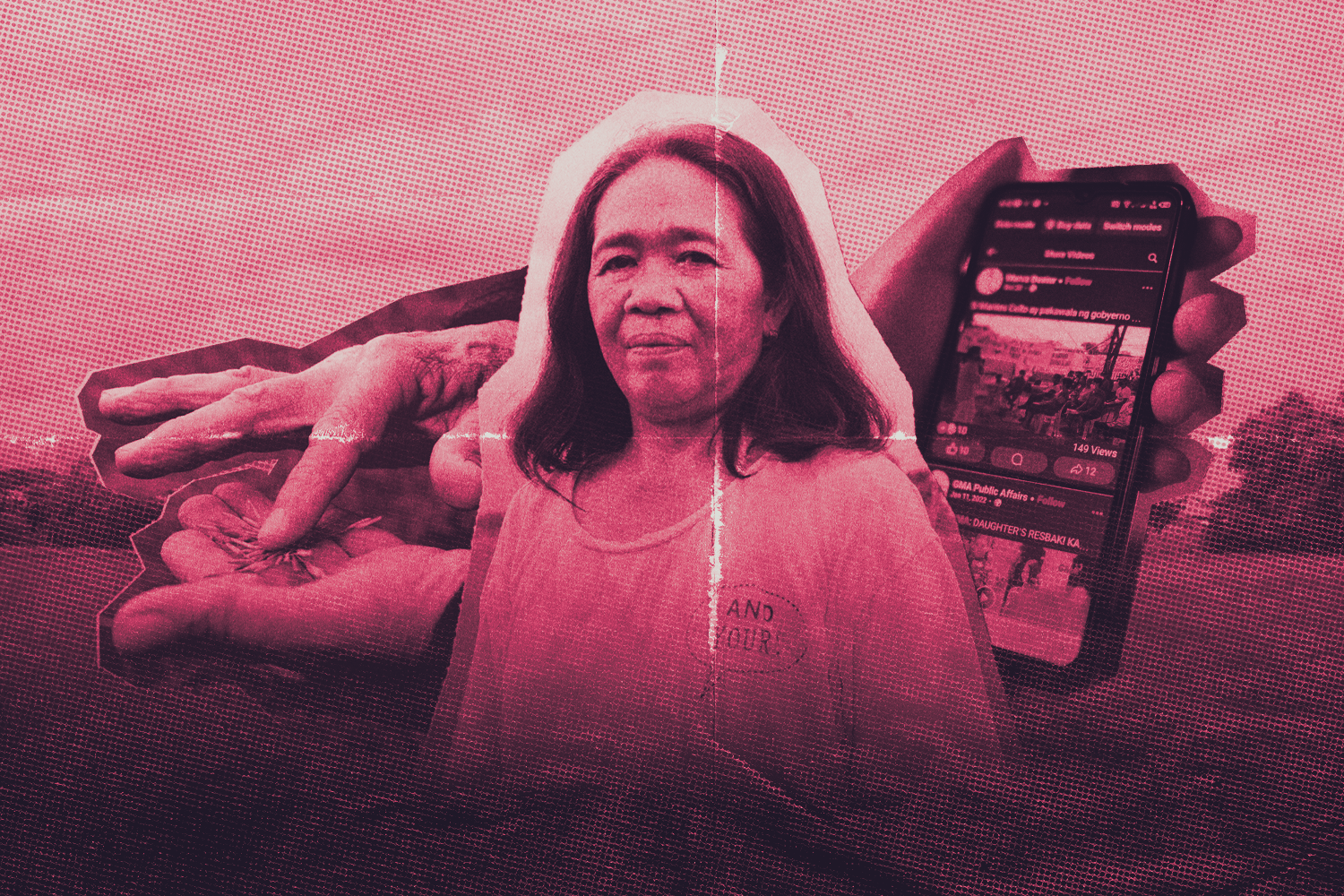
The story of farmer-leader Marites “Nay Tess” Cello unfolds as a microcosm of a broader and troubling pattern. It reflects not only decades of agrarian struggle but also an intensifying environment of state surveillance, red-tagging, and militarization across the Philippine countryside. Amid intensifying threats, red-tagging, and economic insecurity, she remains resolute in her decades-long advocacy for land reform and farmers’ rights in Camarines Sur.
Marites “Nay Tess” Cello has long served as a farmer, organizer, and community leader in Concepcion Grande, Naga City. As a member of the Samahang Magbubukid ng Concepcion Grande and provincial affiliate of DAMPA (Damayan Ning Parauma) in Camarines Sur, she remains at the frontline of the struggle for peasant rights and genuine agrarian reform.
A Life Anchored in the Soil
Like many in Sitio Balatongan, Nay Tess depends on rice farming for survival. But declining palay prices and high production costs have plunged many into deeper poverty.
“₱9 na lang ang kilo ng palay, pero mahal pa rin ang bigas,” she said. “Isang cropping, umaabot ng ₱40,000 ang gastos. Tatlong beses sa isang taon kami nagtatanim kung may kapital. Pero madalas, pagkain lang namin ang napupunta sa ani.”
Even education remains out of reach for many. “Sa populasyon na more than 300, apat lang ang nakakapag-aral sa kolehiyo,” she shared. Farmers are often forced to borrow under exploitative terms: “Kung uutang ka ng ₱10,000, kailangan mong bayaran ng sampung sako ng palay. Lugi ka na agad.”
Under Watch: Militarization and Surveillance
In March 2022, Sitio Balatongan was put under an abrupt military presence, which sparked fear among residents. “Dalawang truck ang pumasok… may mahahabang baril at uniporme,” recalled Nay Tess, referring to soldiers from the 83rd and 9th Infantry Battalions. “Anim ang sundalong nakabantay sa paligid ng bahay ko. May drone pa sa bubong namin.”
She stayed locked in her room for three days, observing uniformed and plainclothes personnel patrolling the community. “Pisikal na harassment, wala silang ginagawa. Pero mental harassment? Napakalaki.”
Efforts to demoralize and isolate her allegedly extended to local men being coerced into nightly drinking sessions with soldiers. “Gusto daw nila akong pasurrenderin. Tinatanong pa ako, ‘Ano kahinaan mo?’”
The presence of military forces in Concepcion Grande is not an isolated case. Human rights groups in Bicol have long documented how rural communities are placed under surveillance and intimidation through civil-military operations. Reports of soldiers disguising counterinsurgency as public service initiatives mirror a nationwide trend. According to the Commission on Human Rights, red-tagging and militarization in peasant communities represent serious threats to life, liberty, and security (CHR, 2024), a concern echoed by international watchdogs such as Human Rights Watch (HRW, 2024).
Legal Harassment and Red-Tagging
From 2022 and 2024, Nay Tess was pressured to sign documents to “clear her name” from baseless allegations. In 2022, she was charged with frustrated murder, accused of being seen in a firefight in Del Carmen, Lagonoy, Camarines Sur with 20 members of the New People’s Army. “Buti na lang, dismissal na agad. Walang hearing,” she said.
However, the military persisted. They told her she’s allowed to join rallies with the condition that her trust goes towards them. She was offered cash to give them information about mass leaders. “Bibigyan daw nila ako ng ₱3,500 at ₱500 allowance daw kapalit ng pagtitiwala. So magsisinungaling ako? Mga lider ‘yon ng mga may problema sa lupa, hindi NPA,” she replied firmly.
Attempts to disguise counterinsurgency under public service efforts were also flagged. “May mga intel na kumakausap sa amin. May isang nagpakilalang taga-Department of Agriculture na ipapasok ako sa life insurance. Binigyan ako ng form nakalagay Department of Agriculture. Pero nakalagay sa logo nila Philippine National Police. May isa pang taga-Department of Agriculture raw, pero nung tinanong ko tungkol sa land use conversion, hindi niya alam. Sabi ko, ‘Huli ka. Lagot ka sa superior mo.’”
These accounts reflect broader concerns in the region. Just this year, Bicolano peasant groups reiterated their call for the abolition of the National Task Force to End Local Communist Armed Conflict, saying that its billions in funds are being weaponized to suppress dissent instead of aiding farmers through genuine rural development.
A Community Divided
Militarization fractured once-close community ties. “Dati kami-kami lang ang nag-uusap. Ngayon, hindi na,” she lamented. Even former allies turned away. “Yung dating presidente ng samahan, ngayon, kasama na ng military. ₱4,000 daw ang kapalit kada buwan.”
To this day, the military continues to monitor their land. After speaking publicly in behalf of AMIHAN during the 2025 EDSA Commemoration mobilization, she was red-tagged. “Kinabukasan, nakapaskil na ang mukha ko sa poste,” she said. “Nag-blotter ako sa barangay at sa Commission on Human Rights. Walang aksyon.”
Despite the Anti-Red Tagging Ordinance in Naga City, she described it as toothless. “Parang Department of Agrarian Reform, may papel pero walang bisa. Dapat may magsasaka at iba’t ibang sektor sa pagbuo ng ordinansa, hindi sila-sila lang.”
Her experience underscores how local ordinances and protective mechanisms remain weak against well-funded state programs. Nationally, red-tagging has been acknowledged by the Supreme Court as a direct threat to life and liberty, yet victims continue to report harassment without meaningful remedies.
Against the Odds, She Stands
In spite of mounting threats and community erosion, Nay Tess remains steadfast. “Dinadalaw pa rin ako ng pulis at militar. Sabi nila tutulungan ako ‘linisin ang pangalan ko.’ Pero salita lang.”
She finds strength in human rights workers and fellow farmers. “Ngayon ako na ulit ang spokesperson ng DAMPA. Kahit takot, tuloy ang laban. Kasi kung hindi ako kikilos, sino pa?”
“Kami ang Nagpapakain sa Bayan”
For Nay Tess, the path forward lies in genuine land reform and democratic rights. “Ibigay ang lupa sa mga magsasaka,” she emphasized. “Kami ang nagpapakain sa bayan. Dapat kami ang pinoprotektahan, hindi tinatakot.”
As Sitio Balatongan continues to reel from poverty and political repression, Nay Tess still clings to hope, not just for her, but for her community and every farmer sowing seeds of resistance in their own land.
These local dynamics reflect a national environment where dissent is met with surveillance, threats, and legal harassment. Since January 2025 alone, local activists have faced arbitrary arrests and terrorism financing charges under murky conditions. Collectively, these developments signal a field operation that forces peasant leaders to choose between staying silent or facing dangers to themselves and their families.
Published in the June 2024–May 2025 print release.
