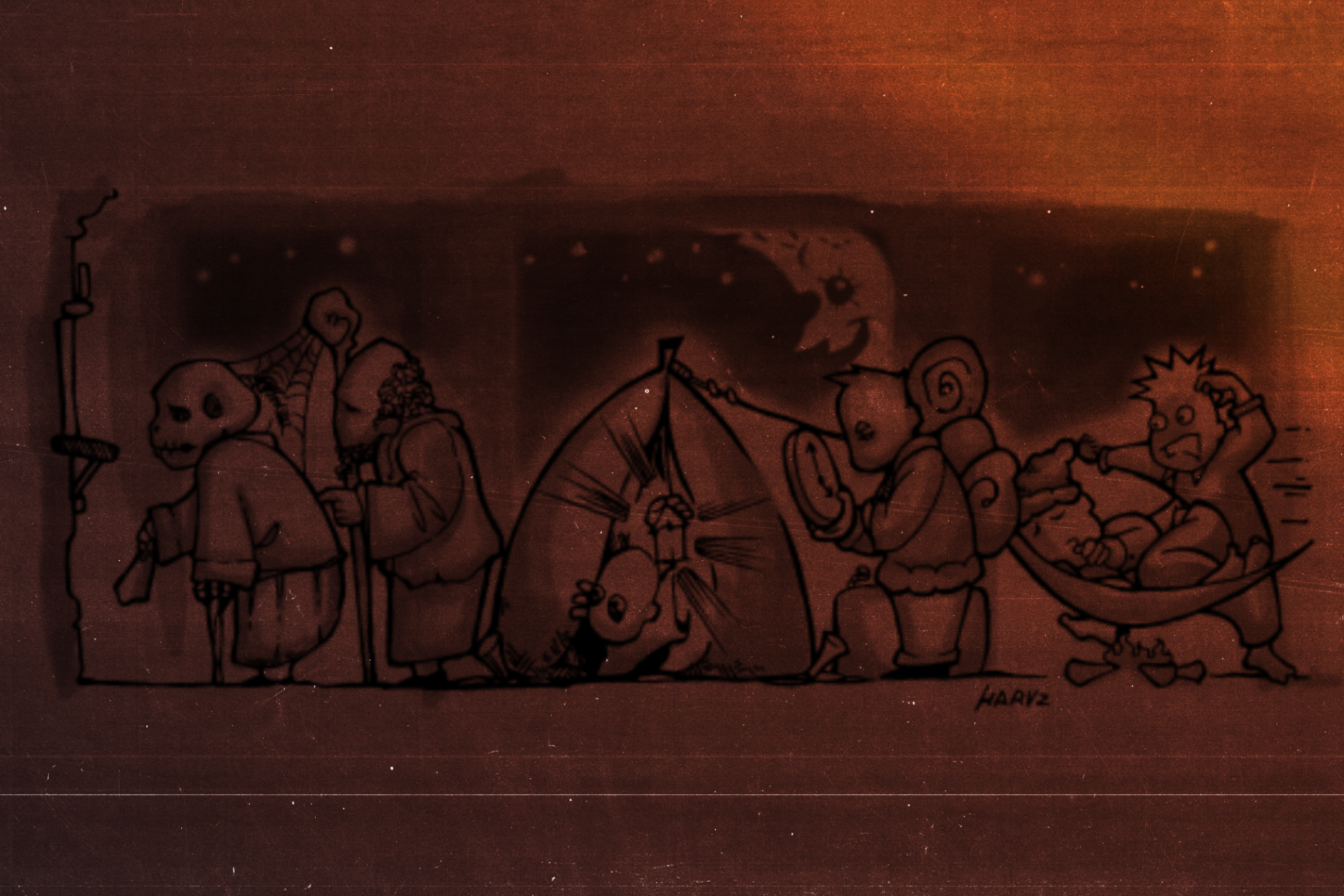
Long queues. Unsettled back accounts. 12 hours of waiting. The heat to match. The rain to beat it. Going to the campus as early as the dark and ungodly hour of 3 a.m. hoping to be the first in line—only to find out there are already people ahead of you.
All these and more mark the trying time that was the enrollment period for the second semester of Academic Year 2024–2025. Scrap the manananggal, the tiyanak, and the heart-eating monster at the LRT; they’re nothing compared to the fear of losing your enlisted subjects—and even more so, the fear of not being able to enlist said subjects at all. This is the final boss.
With this final boss of fears in mind, forth the students went—in the wee hours of night outside the campus—rain, hunger, danger, and all. This, thus resulting in a line that stretched from the campus’ main gate to the Bagumbayan Barangay Hall—where you’ll find Phenelope, a Psychology freshman who arrived there at 6 a.m as it was raining.
“Despite the weather, the guards didn’t allow anyone inside the campus until 6:30 AM, so we had no choice but to wait in the rain. Once we finally got inside, there was another long wait just to get a queuing number. I received mine at around 9:20 AM—and I was number 563,” she explained.
“I was genuinely shocked by how chaotic the process was. As a freshman, I didn’t expect it to be like that, especially not at Ateneo de Naga University. I had expected a much more systematic and organized procedure,” Phenelope, who ended up waiting for six hours more to fulfill her transaction, further aired out.
Meanwhile, for Francine, a sophomore student of Legal Management—as well as for her roommate from senior high school—the day started quite earlier.
“Isa ako sa mga nag-line ng 3 a.m. since sa Ateneo Avenue lang din naman ako nagre-reside. Nung una, tumatawa pa kami ng friends ko kasi sobrang aga ng 3 a.m. Pero nakikita ko na sa Facebook posts & stories na mahaba ‘yong pila tapos may pumila na nang 5 a.m. so na-feel ko na kailangan ko talagang pumuntang maaga. Kaso pagkalabas namin ng dorm, it turns out may mga nauna na pala sa amin. May mga students na pala nagla-line simula pa 1:30 a.m. ” she recalled.
Francine, along with the others in dire wait, was finally let inside the campus at 6 a.m. 79th in line, she finished her business three hours later. She notes, disappointingly, the sight of people cutting in line and, thankfully, the relief brought on by her snacks, water, umbrella, and companion—the essentials to quench hunger, boredom, and the dismal weather.
Their troubles are shared by Euwynn, a Psychology junior, who waited for eleven hours to settle his enrollment dues. “Physically and mentally tiring ang whole day, even though may online form to see [the queue], hindi pa rin nawawala ang takot na malampasan at hindi makabayad sa tamang oras,” he said.
How did we get here?
Flash to the 6th of January 2025, which saw three things transpire at once: the resumption of work after the Christmas break, the enrollment period for college students, and on top of that, the enrollment period for senior high school students.
With these three things at once, what comes of it is an influx of senior high school and college students vying to settle their enrollment fees and back accounts in order to activate their University Web Enrollment System (UWES) account, enlist their subjects, and secure them as early as possible.
Note: As Early As Possible—which online payments do not guarantee, as they are usually reflected in student accounts after two to three days—four to five if it stretches over the weekend. And as the fear of deletion and inability to enlist lingers, students cannot afford to wait. So they pay physically, onsite, and up-front, which, in contrast, is reflected immediately. And even when students do pay online, they grapple with the looming uncertainty and thus take matters into their own hands.
Take, for example, the experience of Ophelia, an Information Systems junior. She paid online via BPI and immediately sent the proof of payment three days before the 6th of January, after initially planning to pay on the 20th of December—when onsite work had ended. So as soon as campus work had recommenced, she lined up to make sure her payment had been processed. 12 hours later at 10 p.m., all her waiting had been for nothing—as she had been told that the teller assigned to processing online payments had clocked off.
“Even though sinabihan na lang ako na mag[puntang] early ulit the next day and magsabi sa nagbabantay na guard [na] i-accommodate ako agad since nakabayad na [ako] online, ‘di mawawala yung pagod na maghintay for several hours,” she said.
University Treasurer Ronald Surara explained the reason behind the wait for the processing of online payments: “It’s not automated.” The tellers themselves also wait for the payment platform or bank to send in the money and report the successful payments. “So kung 1000 [students] ang nagbayad sa online, garo ka man sana may 1000 [students] na nakapila diyan. So itong teller diyan na naka-assign for online [payments] saro-saro yan o-O.R.-an,” he explained.
Another limitation that these online payment platforms pose is that they cannot themselves verify the accuracy of the information that the student or guardian filled in. If, for example, the name or ID number that the payer wrote is incorrect, it will cause confusion on the teller’s part as it does not match any student’s. “It will be hard for us to [verify]. ‘Kay isay daw hali ning bayad na ini? Mayo man kaming estudyanteng arog kaning name.’” Surara explained. This confusion thus delays the reflection of the payment, as it is only reconciled once the student reaches out to the Treasurer’s Office.
Noting these limitations and the lack of trust it caused among students and parents, the Treasurer’s Office worked to speed up onsite transactions, setting up additional stations in the MR15 rooms and Human Resource Management Office on the 9th of January. “Ang commitment ng Treasurer’s Office is [that] we’ll finish kahit mag-overtime talaga,” Surara said.
It was also on this very day that the deletion of subjects was moved to 13th of January at the earliest, as per a memorandum from the Office of the Vice-President for Higher Education—relieving the students temporarily of their worry.
Deficiencies that caused the delay in the activation of UWES accounts had lied not only in the Treasurer’s Office, but also in the College Registrar’s Office (CRO). For some students, it was a quick fix.
It certainly was for Ophelia who, before having to settle her payment uncertainty, first had to settle her F137 deficiency. This, as it turns out, had already been settled by her alma mater a month prior—yet students still had to line up to update the registrar themselves for them to get through to the next step.
Unfortunately, this was not the case for everyone. It certainly wasn’t for a student from the College of Humanities and Social Sciences who resides in Masbate, whose Form 137 deficiency turned her into a late enrollee. However, she admits her own lapses in this regard, having failed to see the notification of her deficiency on her MyADNU portal.
With this, University Registrar Marymon Salvamante stresses the importance of the MyADNU portal in its role as the communication medium between the school’s management and its students. Here, they are notified of deficiencies and developments, and are thus urged to take appropriate action.
Salvamante also shares that deficiencies in requirements that hinder students from enrolling arise from the problem of their unsettled back accounts from their previous schools. To solve this problem, there comes the power of the promissory note, which considers the situation of the students and allows them to push through with enrolling.
Come the next semester, it was time for a change.
Ophelia, who was forced to grapple with uncertainty as to the reflection of her online payment, echoed the suggestion of many other students: “Dapat talaga real time yung processing of online payment. And since enrollment season talaga, maraming magbabayad, [dapat mag]dagdag sila ng windows to accommodate cash payments.”
These hopes, a semester later, would find themselves heard.
On 21 July, AdNU - Management Information Systems officially launched AdNU-Pay, which was dubbed as a “key milestone under the Computing Systems and Innovations Office (CSIO)’s Smart Campus roadmap.” This allowed for online payment through multiple channels, 24/7 access, and real-time reflection. According to University Treasurer Ronald Surara, this minimizes the human error that once hindered the unautomated online payment system.
Phenelope, who, much to her shock as a freshman, described last semester’s enrollment as “unsystematic, slow, and inconvenient,” described this semester’s as “fast, convenient, and generally easier to navigate.” This was, aside from AdNU-Pay, thanks also to the service of the Instructional Media Center (IMC) as a centralized venue for enrollment-related payments, where multiple tellers, guides, and ushers were deployed for maximum efficiency.
In acknowledgement of last semester’s mishaps, more improvements were also implemented: help desks for inquiries, additional TVs for the monitor of queues, the consideration for back accounts that are less than PHP 500.
Still, not all wishes were heard—and perhaps, for good reason. For one, both Salvamante and Surara opposed the removal of the subject deletion dates. Both noted that the absence of deletion dates back then posed major problems, citing the experience of subjects being full of students who have not even paid yet—leaving other students with the only choice to simply not enlist or even enroll. This value of fairness is also the reason why year- or department-based enrollment is not feasible—for who must go first and who must go last?—thereby breaking the promise of equal chances.
Come the next semesters, here’s to fighting for more changes for the better.
What makes the second semester’s whole ordeal all the more unsettling is the accounts of past alumni, stating that nothing has changed in decades, or worse, that things have gotten even worse—with Ateneo’s old systems still in place. For them, it was who could run the fastest; and for us, it was who could arrive the earliest.
What's next?
Unlike horror movies with a definite conclusion, however, this semester's enrollment is not the finale—nor will any future enrollment be. One question remains: Will the next enrollment be as smooth as this semester's? Only uncertainty is certain. But then again, things can only get so uncertain to an extent. Fortunately, there are things we can do so we are not left with mere uncertainty as an answer.
First, we must always stay vigilant as if there are unspeakable horrors always lurking behind this uncertainty. The role of that one character in a group of protagonists who’s constantly on the guard, with a dos por dos in their hands, falls on us. However, just as that dos por dos is useless if not swung, vigilance is futile if we are going to watch but do nothing.
Second, we must always pressure the university to be consistent, proactive, and to continuously improve. By extension, that pressure must include the student leaders who are supposed to represent us. Even if, hypothetically, the process achieves utmost perfection, we cannot ignore the point of the process—we are there to pay in order to be enrolled. That fact alone entitles us the right to assert our demands, and that these demands be listened to.
Not only are we the primary recipients of the university’s services, most important of all, we are stakeholders. Without students, there would be no university to call. It is our money which funds the institution. We should not be scared to stand for simple improvements, a bare minimum, because it is their job, the wage of which comes from the fees we pay.
Because hypothetical scenarios aside, nothing is perfect—including the enrollment process—which means there will always be flaws. And as long as flaws exist, that means there will always be room for improvement. There will always be other ways to optimize the process beyond what have previously been suggested, and what Surara, Salvamante, and the university administration have tried and declined (or declined without trying). All of these, and considering unexpected delays and untimely mishaps happen.
Lastly, we must extend this battle outside the enrollment process. There is not just one, but many monsters. There is not just one part, but many in a horror anthology. The enrollment process is just one of the many services the university gives. We must never tire of upholding our calls.
Nothing to shake our nerves and rattle our resolves, and everything to shake and rattle the university for services that we, the students, deserve. Nothing to fear about asking for what we pay for—we have a better institution to win.
Editor's Note: This article was originally published in ThePILLARS Volume LXI (June 2024–May 2025) issue. It documents the enrollment experience during the second semester of Academic Year 2024–2025. References to enrollment procedures and student experiences reflect the circumstances at the time of reporting and may not represent current university policies or practices.