
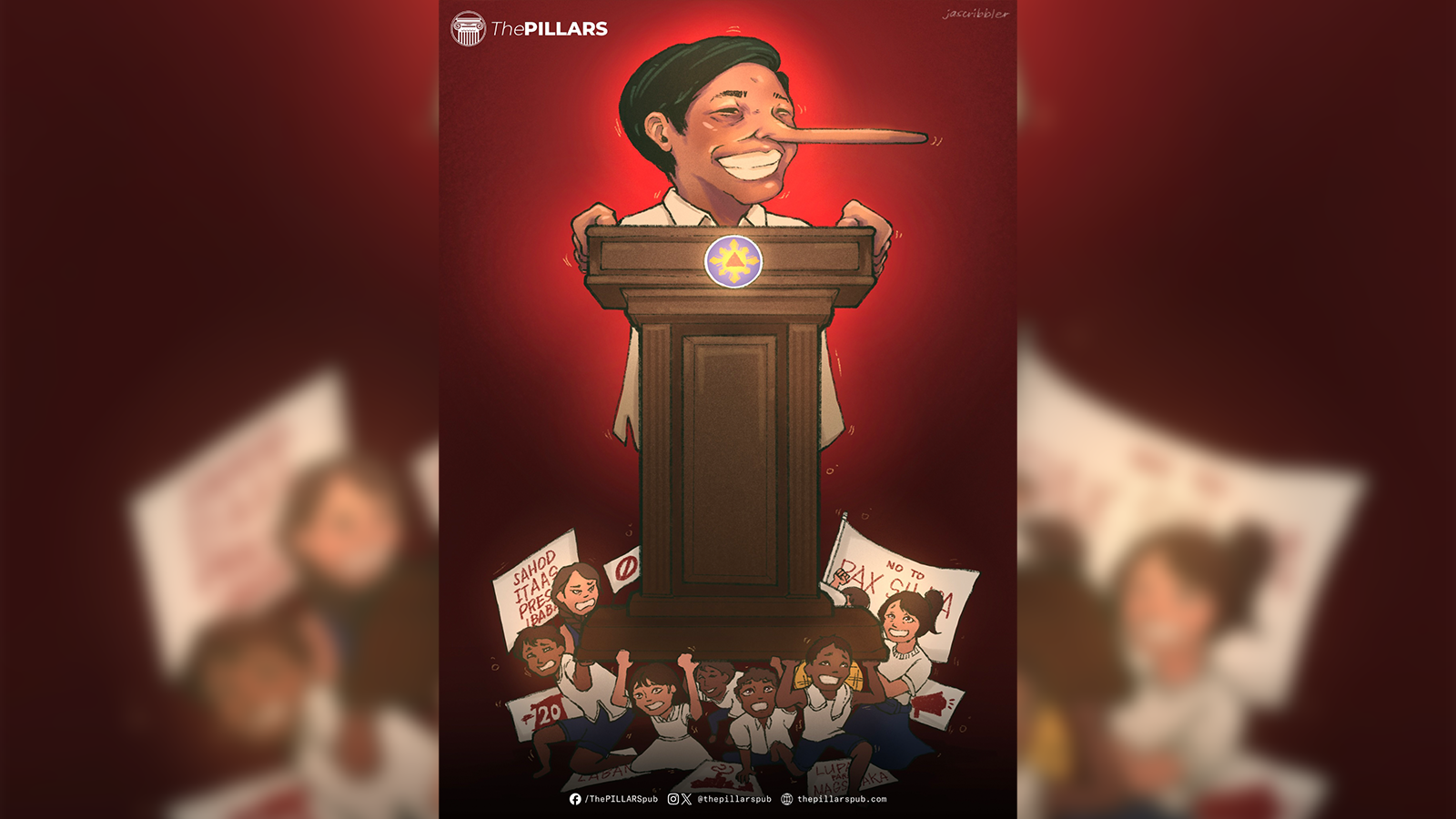
FOR THE FIFTH TIME, Marcos Jr. once again stands on the podium of the Batasang Pambansa to deliver the administration's so-called State of the Nation Address.
More than anything, the preliminary rituals now-attached to the address speaks the truth louder than the SONA itself; bureaucrat-capitalist elites drape themselves in the finest barongs and shiniest gowns as the rest of the Filipino people suffer under a backwards economy run by local ruling classes and a kleptocracy managed (if one may call it that) by both incompetent clowns and devious professionals who serve only their own, their cronies’, and either the United States’ or China's imperialist interests.
In his 2025 SONA, Marcos Jr. publicly condemned corruption, telling involved officials to be ashamed of their actions. Months later, major anomalies in government flood control projects came to light, exposing high-profile figures and contractors—including the Discaya family and former representative Zaldy Co. Yet, despite public outrage and investigative revelations, genuine accountability remains elusive and meaningful justice has yet to be served to the Filipino people.
The flood control scandal was never merely about overpriced infrastructure. It became an indictment of an entire political system that has normalized public money flowing into private pockets while communities drown under the very projects meant to protect them. Billions of pesos continue to be poured into flood mitigation despite recurring disasters exposing defective or unfinished works. The president who once declared that corrupt officials should “be ashamed” now presides over an administration where investigations remain selective, prosecutions uncertain, and political alliances appear stronger than public accountability. The problem has never been the absence of speeches against corruption. It has always been the absence of consequences.
Outside the walls of the Complex, the real State of the Nation is evident: from the families living in the esteros of Metro Manila to the countryside, the message is a hundredfold clearer than the usually celebrity director-led coverage—the country has, for the longest time, been experiencing a never-ending crisis. (Note: Presidential Communications Office Undersecretary Claire Castro has claimed that this year's SONA will not involve any celebrity director; regardless, the point stands.)
The administration proudly points to the Philippines’ attainment of upper-middle-income status as evidence that the economy is moving in the right direction. International classifications may indeed recognize a country’s average income, but averages have never fed an empty stomach. They do not explain why millions of Filipinos continue to survive on wages that cannot keep pace with inflation, why families remain one illness away from financial ruin, or why homelessness and hunger persist even amid declarations of economic growth. Economic labels are meaningful only if ordinary people experience them. Until then, “upper-middle income” risks becoming another statistical victory masking everyday deprivation.
Conflicting Narratives
At the bustling streets, the SONA ng Bayan (People's SONA), organized annually by the Philippine left, serves as a counterpoint—the counterargument against the administration's claims to development.
Every year, while the administration narrates its accomplishments inside the halls of Congress, thousands gather outside to deliver another address altogether. The People’s SONA did not emerge because dissenters refused to listen. It emerged because many Filipinos no longer see themselves reflected in the official narrative. Organized by progressive organizations, workers, peasants, indigenous peoples, women, youth, and other marginalized sectors, it serves as a parallel account of the nation—one measured not by investment pledges or GDP figures but by empty rice bowls, unpaid labor, demolished homes, political prisoners, and communities displaced in the name of “development.” This is the reality of the nation.
The real state of the nation is fascism and repression. The real state of the nation is hunger and abject poverty. The real state of the nation is landlessness and modern-day slavery. The real state of the nation is systemic miseducation. The real state of the nation is discrimination and disregard for human rights. The real state of the nation is gender inequality. The real state of the nation is a disgraced government.
The real state of the nation is found in workers whose wages lose value faster than they can earn them. The real state of the nation is found in farmers who till land they will never own, producing food they themselves cannot always afford to eat. The real state of the nation is found in fisherfolk pushed farther into dangerous waters while defending seas increasingly contested by foreign powers.
The real state of the nation is found in students forced to study inside classrooms burdened by shortages, while education remains inaccessible to many who need it most. The real state of the nation is found in communities still rebuilding from disasters that return with greater force each year, even as billions are reportedly allocated to flood control.
The real state of the nation is found in journalists, activists, organizers, and ordinary citizens who continue to face intimidation, surveillance, arrests, violence, and death for exercising rights supposedly guaranteed by the Constitution. The real state of the nation is found in every Filipino forced to lower expectations because demanding dignity has become mistaken for demanding too much.
The real state of the nation is harrowing, disturbing, and revolting.
We must never blindly believe anything a known liar claims. We must continue to resist any misrepresentation that covers up the real state of things. To those with enough privilege to not live the social realities of the overwhelming majority of the masses—look around, remain critical, and keep asking questions.
Has he ever had to portion half a kilo of rice to feed a family of eight and pair it with only soy sauce? Has he ever stood in line under the sun just to ask for a government subsidy? Has he ever had to bathe in dirty, mud-tinged water piped in by a utility corporation? Has he ever felt the sting of rising cost of necessities while surviving on a stagnant minimum wage?
The ultimate rebuttal to the half-truths and omissions of the president's SONA is the lived experiences of the people. And the ultimate response to a rotten state is the power of the people.
