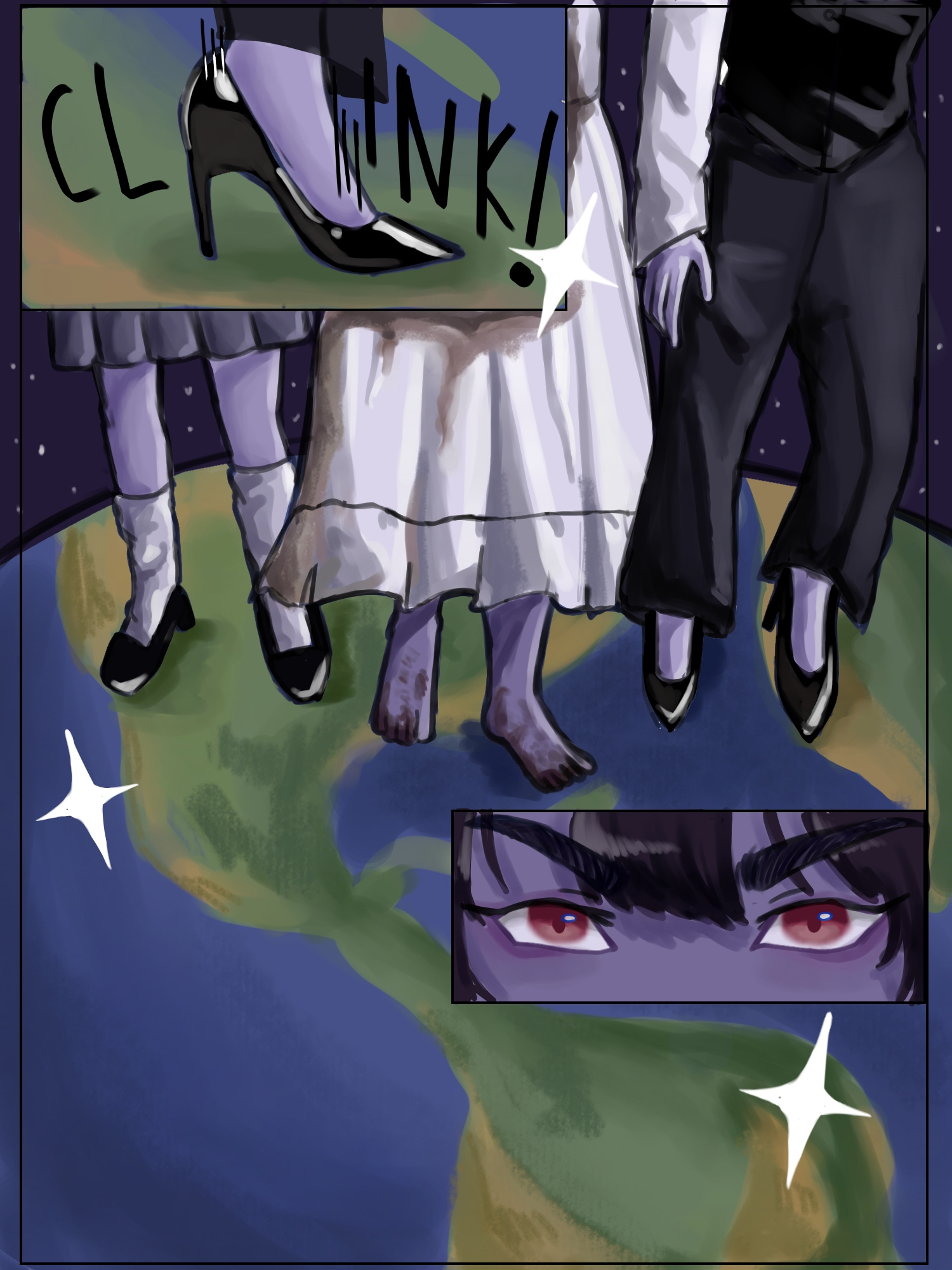
HEELS WERE designed to slow women down. Smaller steps, straighter posture, less room to run ahead. Society choreographed our movement before we even learned our own names.
Graceful. Careful. Contained.
Heels were never just fashion — they were instruction.
But smaller steps did not mean a quiet entrance. And although stripped from it, walking on heels did not mean lesser power. Society least expected women to walk into power wearing them. Perhaps it forgot that if there is one thing heels give women, it is elevation.
For centuries, society engineered femininity like architecture. Women were to be beautiful, structured, and positioned exactly where authority could tolerate them. Elegant, yes. Decorative, yes. But never threatening. Women were told to be emotional, irrational, too delicate for power. Yet history proves otherwise. The problem, however, is not only that women were excluded from power. The deeper question is what kind of power are we stepping into in the first place.
Click.
In retrospect, the system has a habit of being distracted by the clicking of our heels when we are where we are not supposed to be heard.
In 1965, a Filipina lawyer stood before the Supreme Court and did something startling. In 1973, Cecilia Munos-Palma was appointed to the Supreme Court of the Philippines, becoming the first woman ever to sit on its benches. During the authoritarian years of Ferdinand Marcos Sr. administration, Munoz-Palma became known for her dissenting opinions — rare and risky at a time when judicial independence was under immense pressure. She disagreed in a system where disagreement could carry consequences. The courtroom, which was once filled with barongs, and baritone voices, was cracked by a clicking sound — it was Cecilia, wearing her heels.
The clicking sound reached laboratories, a space that assumed geniuses had a Y chromosome. Fe del Mundo came in like unexpected thunder in 1936 when she applied at Harvard Medical School during a time when the institution did not formally admit women into its medical program. Legend has it that administrators, upon reviewing her application, assumed that “Fe” was a man and sent the acceptance letter anyways. Long and behold, Del Mundo walked with confidence and elegance through its gates — it shocked them for sure.
Quite ironic, is it not? An institution not expecting a woman, yet they heard the clicking sound they once thought was noise. Del Mundo completed her studies and eventually returned to the Philippines where she would transform a pediatric hospital and pioneered research on infectious diseases affecting Filipino children.
Click.
However, representation alone was never the point. A woman entering power does not automatically transform the system that power was built to protect. The stories of women breaking barriers are significant, but they should not be mistaken as proof that the system suddenly works. If anything, they reveal how these systems were built to exclude women in the first place — and raise a deeper question about who those structures ultimately serve.
Modern feminism often celebrates the women who make it to the top: the CEOs, the billionaire, the president — as if their success alone proves the system works. If a handful of women rise to power while millions remain underpaid, exploited, and invisible, who exactly is empowerment for?
The majority of women are not CEOs. They are workers.
They are factory employees stitching clothes in overheated rooms. They are farmers cultivating land they do not own. They are nurses, vendors, domestic workers, teachers, mothers balancing multiple jobs for survival. For them, empowerment does not look like a corner office; it looks like fair wages, safer workplaces, land rights, healthcare, and dignity.
Click.
But not all women were given heels. Some stand barefoot on soil cracked by heat, their feet hardened by years of planting rice they will never own.
Across the Philippines, women farmers rise before dawn, tending land that feeds the country while remaining among its poorest citizens. Many of them work as unpaid family laborers or seasonal farmhands, their contribution invisible in both statistical celebrations. These women rarely appear in glossy Women’s Month tributes because they are not CEOs, and they are not keynote speakers. They are the ones harvesting the food served at those events.
If heels echo in courtrooms and boardrooms, the footsteps of working women echo somewhere else entirely — in rice fields, factory floors, crowded markets, and picket lines. Their footsteps are much quieter, but no less revolutionary.
Click.
Or perhaps something even quieter: the soft press of bare feet against the ground. Reproductive rights are another battlefield. Abortion remains illegal in the Philippines under the Revised Penal Code, with no exceptions even for rape or life-threatening pregnancies. As a result, hundreds of thousands of Filipino women resort to unsafe procedures every year, and around a thousand die annually from complications. The laws supposedly written to protect life and end up endangering the very women forced to live under them.
The burden falls heaviest on the poor: women who cannot afford safe care, who face stigma even in hospitals, and who are often denied treatment out of fear they will be reported to authorities. The women most affected by these policies are not the ones sitting in legislative halls.
Additionally, sexual harassment is not just whispered in crowded jeepneys or tolerated as “banter” in group chats. Right now, it is spoken aloud in government offices by public officials. Just recently, Quezon City Rep. Bong Suntay used a House committee hearing to make a sexually suggestive reference to actress Anne Curtis, justifying it as imagination rather than misogyny. His remarks were condemned by women’s rights advocates, lawmakers, the Philippine Commission on Women, actors’ guild, and even some of his colleagues, noting that reducing a woman to an object of sexual fantasy in an official hearing is not a harmless joke but a reinforcement of a culture that tolerates harassment and objectification as normal.
This incident reflects a wider culture that still treats women as props in commentary rather than citizens with dignity and agency — a culture that becomes even more dangerous when those in power normalize it.
This stands as evidence that even in 2026, women in this republic continue to have their bodies and voices commodified, joked about, and defended as “compliments” by those entrusted with public office.
Click.
The amount of women fighting back against these systematic and structural struggles are not only what we see trending online. They are the women marching in the streets every 8th of March; the workers, farmers, students, mothers. These are the very women who gave birth to Women’s month. Long before the language of “girlboss” feminism existed, working-class women were organizing for something far more radical than representation. They demanded wages, labor protections, voting rights, and the restructuring of a system that profited from their exploitation.
So perhaps the question is not simply whether women can climb the social ladder; it is who built the ladder, and who is left underneath it. Because empowerment cannot only mean placing a few women at the top of the same hierarchy that keeps most others struggling at the bottom. True liberation asks for something harder, and it asks whether the hierarchy itself deserves to exist.
Click.
This is the modern Filipina — not just the woman breaking ceilings in boardrooms, but the woman organizing unions, defending ancestral lands, marching against violence, and demanding rights over her own body. She inherits a history that taught patience and silence, but she also inherits resistance. Her heels do not just echo through courtrooms and corporate halls. It goes beyond picket lines, farms, classrooms, and crowded city streets. And each step asks the same question: For whom is empowerment really meant?
Click. Click. Click.
The clicking becomes stronger, louder, and much more powerful. The answer is not in the few who sit at the top of hierarchy; it belongs to the millions of women whose labor, whose voices, whose very bodies hold society upright. And whether their heels are polished or bare, in concrete or soils, do not whisper but shatter ceilings, disrupt silence, and demand attention.
Society designed rooms to constrain women, to muffle ambition, and to condition obedience. But it never accounted for the collective cadence of millions of women stepping together, refusing to be polite, refusing to be quiet, and most of all, refusing to be small. When those heels belong to the masses, the sound is no longer ignorable, and thus pulses, shakes, and reverberates, demanding not reform, not patronizing praise, but a reckoning with the very hierarchies that built this inequality.
Click. Click. Click.