
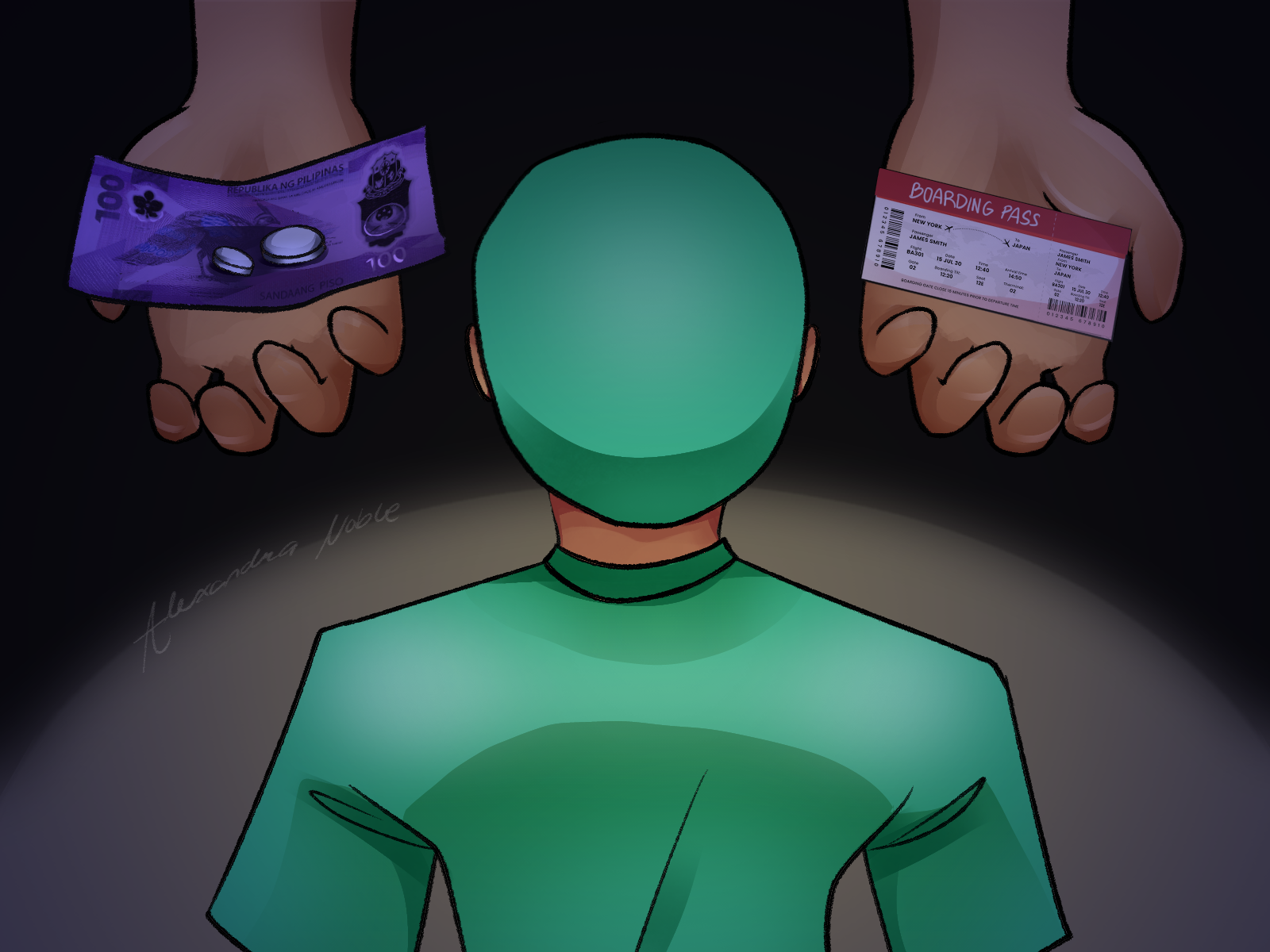
A RECENT TRIP to the doctor for a check up had been one very much needed wake up call for me. What do you mean I had to wait for long hours? When will the doctor arrive? Why do almost every hospital I go to have long lines and long waiting times? I had mixed feelings thinking to myself. Then I also realized— this doesn’t just happen in hospitals. Other institutions and facilities, with great emphasis on the medical related ones, face challenges in finding professionals who will serve the Filipino masses. However, looking at the batches of graduates and Licensure Examination Passers that our country proudly boasts, one might just stop and ask: where do all these licensed people go?
A column from The Manila Times highlights how a majority of the 500,000 to 700,000 annual graduates in the Philippines only have two options: either to secure a license and work abroad, or to become part of the workforce that will serve the Filipino people. Sentiments online regarding the country’s state in terms of labor and employment even mentioned how in most cases, college tuitions far exceeded their pay after graduating. With all of that in hand, is it truly the sector that fails the system? Or is it the system that fails its country in general?
The Part of the Boat One Belongs To
For a majority of degrees that require a license for professionals, one could argue that review centers are literally everywhere to help graduates pass and secure their needed licenses. But with that need, the question arises: are these review centers accessible and practical for the whole lot of aspiring licensed professionals? While it is not an imperative to attend one, the need to be part of a review center in order to pass and obtain a license seems more than a necessity these days. Not disregarding the capable and outstanding individuals who have made their own way out: it’s just that these review centers, while they maximize passing rates and boost confidence, still do not guarantee a license at all.
Days and nights of tireless work and effort to maximize the chances of passing, tears and frustration amid piling pressure and tension, and money paid for the center for review. The financially incapable ones? Studying with their own resources. Making their own ends meet. Usually at a public library to gather more resources and information. While the lot says they would fight on the same boat, the reality is that they’re not. On the very boat, some were at a disadvantage. On the same boat, some have to fight on their own. On the very boat, some were still above the rest.
A Title to be Worn for Recognition
Moving on, the day of the examination comes. You come inside, “ready”: practiced, confident, eager. Bringing with you the knowledge you obtained from university and from the mock exams at the review center, you then proceed to the battlefield with questions that carefully gauge professionals’ knowledge about their field. In spite of the overly complex and brutal battle, you come out with a breath of relief, and once again, you wait. Hoping you would make it through, hoping your efforts will not have to go to waste. The results come out and with your name included in the passers, then comes the million dollar question: now what?
With a license, you now ask yourself. Would you then be willing to start your own firm or clinic? Because truth be told, in the Philippines, it seems like a necessity for licensed professionals to build their own firms for them to maximize their license and its benefits. However, that road is more often than not, disregarded. As Filipinos see the country’s inferiority to other countries especially in terms of work opportunities and employment wages, it is more likely that these licensed professionals see “working abroad” as the only door to use their license as keys to a successful and more fruitful career. However, truth be told: even abroad, these licenses are oftentimes disregarded and are not much celebrated as much as it is here in our country. For the other countries, it’s a minimum requirement, or sometimes, an accessory, a title to be worn for additional recognition.
Systemic Failure
With all these discussed and brought to light, we can further ask ourselves: what is it truly that Filipino institutions are building? What is it that the Filipino system intends to produce? Do we really mean to create professionals that will simply leave the country for a better job and a better life? Even with lapses in hospital facilities, even with challenges in terms of medical workforce, or even with shortcomings in the education sector, it is not these individual branches that should take the blame. Blame is not even the appropriate approach for it. If I am to be asked, the much more acceptable term could be responsibility.
If we actually think about it, whose responsibility are all of these that happen around us and affect our lives as people of this country? It’s the government’s. And to be fair, from a democratic country such as ours, it is our responsibility in turn to ensure that the people we elect for government positions are the ones that will serve us. That is the only way to reverse or, at the very least, do something about this systemic failure that has been occurring and holding us down to achieve a better country with a better system.
Oftentimes, Filipinos are known to be resilient. We are known for enduring, enduring, and enduring: from deluges that wash away hopes and livelihoods to systems that slowly but surely transform our lives and make us suffer. The difficulties from studying in a university, passing a board exam, and securing a job to maximize the license one professional has earned surely deserve better than all of this. Somehow, we deserve a system that recognizes and generously rewards all the hardship that we have gone through. After all, what are all of these for if not for the betterment of the people, right?
With that, this is your wake up call. For how long must we endure all of these still? Sure enough, we don’t deserve this. Families, students, professionals, and every Filipino do not deserve this. We deserve more from the system. We deserve more from the government. We deserve better than a system that fails the people it’s supposed to serve.
