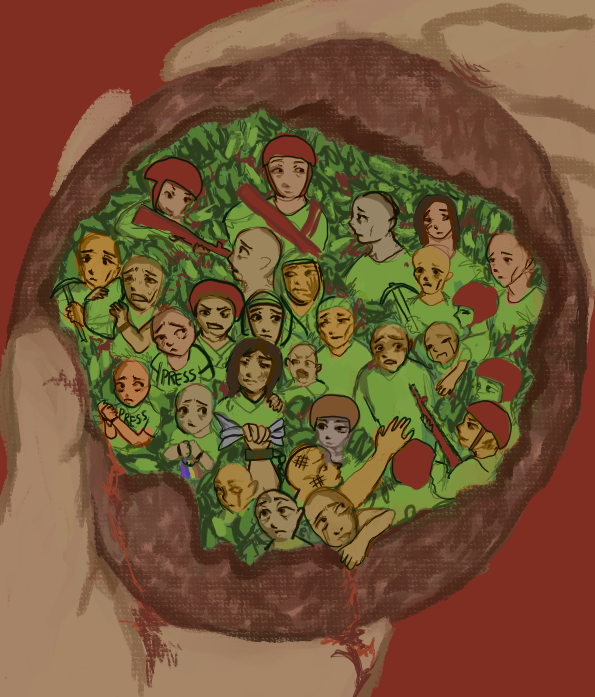
IN RECENT MONTHS, we see a disturbing contradiction across social media feeds. On one side of the screen, we marvel at the soft, pistachio-filled interior of the "Dubai chewy cookie." On the other side of the world, the same region that lends its name to its confection is engulfed in escalating military violence, with airstrikes, civilian casualties, and humanitarian crises dominating international headlines. Yet in the architecture of social media, these realities rarely occupy the same emotional space. The Middle East becomes both a luxury brand and an area of devastation—one trending, the other scrolling past.
This phenomenon illustrates how quickly how online platforms transform food into spectacle. Viral food works perfectly in the attention economy—short, visually satisfying, and endlessly repeatable.
Meanwhile, the same region that gives the dessert its glamorous branding is experiencing intensifying conflict. In March 2026 alone, airstrikes and military operations across the Middle East—particularly in Gaza and neighboring areas—have killed civilians including children and pregnant women. Since the United States and Israel struck Iran on 28 February, at least 2,000 people have been killed throughout the Middle East. Reports describe deadly attacks on families and bystanders amid ongoing military operations, with dozens killed in a single day and hundred more casualties accumulating during the broader conflict.
The disturbing irony is not simply because these two realities exist simultaneously. It is that one thrives precisely because the other is easier to ignore. Social media platforms reward content that is digestible, visually pleasing, and emotionally complicated. A dessert that cracks open to reveal pistachio cream is algorithmically perfect. War is not. War requires context, historical understanding, and sustained moral attention—none of which fit easily into a fifteen-second video designed for engagement farming.
This also reveals something deeper about the political economy of attention. Platforms profit from virality, and virality favors consumption over confrontation. Brands, influencers, and advertisers benefit from a steady flow of aesthetic trends that keep audiences scrolling and spending. Political suffering, by contrast, is difficult to monetize. Graphic images risk moderation; complex narratives reduce watch time; tragedy interrupts the rhythm of consumer entertainment. In this ecosystem, apolitical content is not neutral—it is structurally incentivized.
The result is a subtle but powerful form of emotional compartmentalization. You might scroll past footage of bombed neighborhoods, displaced families, or emergency hospitals—and seconds later encounter a recipe tutorial for the same dessert trending across global feeds. The algorithm does not distinguish between these realities; it simply arranges them according to engagement probability. Tragedy becomes background noise between moments of entertainment.
We have seen this before. During the ongoing genocide in Gaza, countless survivors, journalists, and humanitarian workers have attempted to document the realities on the ground. Yet their posts often compete with waves of unrelated viral trends, celebrity gossip, and consumer content. The digital public sphere becomes crowded with simultaneous narratives, and in that saturation, suffering is diluted.
This is not to argue that we must stop enjoying desserts or participating in harmless trends. The problem lies not in the chocolate itself but in the ecosystem that surrounds it. Social media encourages a form of consumption that feels apolitical precisely because it is detached from the material realities of the world that produces its symbols. A place like Dubai can be reduced to a flavor profile while the broader region burns.
And perhaps the most disgusting part of the story: the algorithm does not merely distract us from war—it teaches us how to live comfortably alongside it. Luxury aesthetics and human devastation appear side by side until the dissonance fades. Eventually, the bombs become just another background element in our doomscrolling.
So the next time a viral dessert from the Middle East floods your timeline, it may be worth reflecting before falling into the bait. Not because enjoying sweetness is immoral, but because the system that makes that sweetness visible often depends on something else remaining unseen. In the digital age, indifference rarely arrives as silence. More often, it arrives wrapped in pistachio cream, coated in marshmallow, and perfectly optimized for your feed.