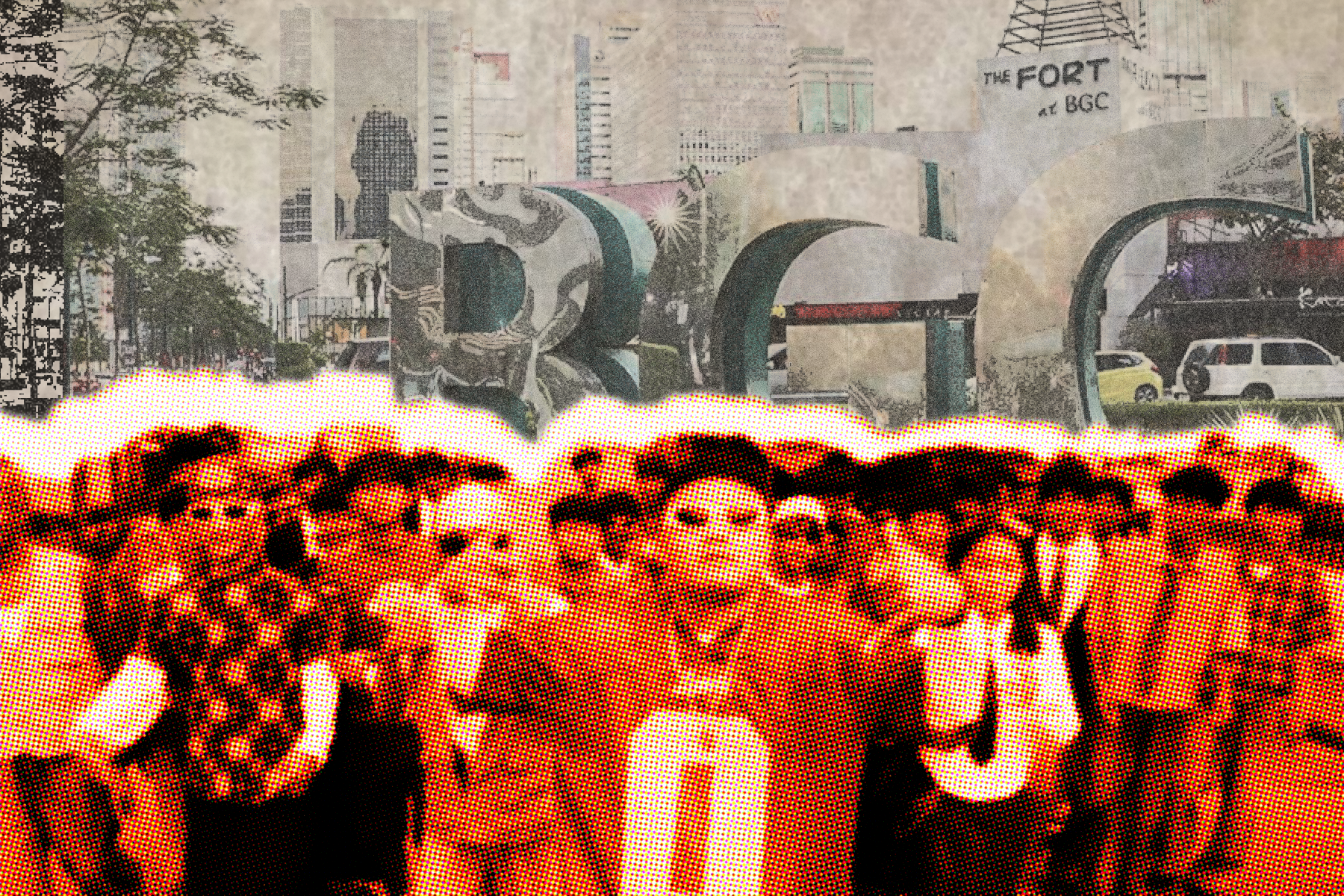
The city welcomes everyone until the poor actually show up
On weekends and holidays, Bonifacio Global City (BGC) changes. The sidewalks fill. Groups of teenagers sit on curbs. Families stroll to take photos. Laughter gets louder. The city feels, suddenly, like a city.
And for a certain class of people, that is intolerable.
In recent months, a familiar complaint has resurfaced: There are too many poor people in BGC. They are called “geng-geng,” or “young stunna.” They are accused, often without evidence, of threatening peace, safety, and decency. Some openly argue that BGC should restrict who is allowed inside.
Strip away the euphemisms, and the message is clear: this place was not meant for them. The outrage is not about crime. It is about class.
The Geng-Geng Moral Panic
The so-called “geng-geng” issue did not begin with the crime spree. It began with discomfort. Videos circulated of security guards questioning teenagers, social media posts complained about “rowdy youths,” comment sections filled with speculation, fear, and thinly veiled contempt. “Geng-geng” is not a legal term; it is a social slur. It collapses youth, poverty, noise, and visibility into a single imagined threat. It criminalizes presence before any crime exists.
There is no verified evidence of organized gang wars, coordinated riots, or widespread youth violence in BGC. What exists are isolated incidents of petty theft, occasional scuffles. This is the same thing found in any dense urban area, handled by the police as routine law enforcement. Thus, what is being policed here is not behavior, but identity. Lower class kids doing ordinary teenage things are treated as threats because they are poor. Loudness becomes disorder, numbers becomes danger, enjoyment becomes “squammy.” This is class profiling.
Lupa ng Bayan
Dismissing BGC as lupa ng bayan is convenient but dishonest. Fort Bonifacio was public land. Its conversion was authorized by the state. Its rise depends on public infrastructure, public transport, public labor, and public money. The city runs on workers who clean its offices, guard its buildings, serve its food, and maintain its streets. The working class did not wander into BGC by accident. They built it and they sustain it. Cities are not luxury goods. They are collective social products.
The anger has nothing to do with safety. It has everything to do with loss of exclusivity. The illusion cracks: that the city can be insulated from inequality, that comfort can be monopolized, that wealth grants spatial priority. The presence of the lower class shatters the fantasy that urban life can be neatly stratified without tension. What they fear is not chaos; they fear equality of access. The elite class is uncomfortable when the poor are visible as it bursts their fantasy of a perfect society. BGC masks their perspective of reality that there are poor people also trying to climb up the social ladder by just simply taking photos and hanging out where the elites are.
The Lie of the ‘Private City’
BGC is constantly spoken as if it were private property. This is a lie, repeated until it sounds natural. Bonifacio Global City is part of Taguig City. It falls under one mayor, one police force, one Constitution. Philippine law applies here exactly as it does everywhere else. No private corporation owns sovereignty over it. What is private is management, not citizenship. None of this gives them legal authority to decide who may exist in the district as a whole. No one needs permission to enter BGC. No one needs to prove purchasing power to walk its streets.
Freedom of movement does not end where wealth begins.
Despite its legal status, BGC functions as an exclusionary space. Street vendors are pushed out. Informal workers are harassed. Security guards enforce unwritten rules about how long you can stay, how loudly you can speak, and whether your presence looks “appropriate.” Spaces that feel public are quietly privatized, and this allows behavioral control without democratic accountability. Urbanists call this pseudo-public space. Ordinary people call it discrimination.
So when the lower class show up in noticeable numbers, the system reacts, not because something has gone wrong, but because something has gone off script.
Decency: The Favorite Weapon of the Comfortable
When exclusion is challenged, defenders retreat to one word: decency. Lower class youths are said to lack it. But decency is not neutral—it is a class performance. It means quietness, restraint, aesthetic conformity, and consumption-oriented leisure. It means knowing how to disappear politely. Historically, “decency” has justified segregation, colonial discipline, anti-vagrancy laws, and urban cleansing. It has always been a way to make exclusion sound moral. This asymmetry is political.
Peace for Whom?
The “peace” being defended is not public peace, but peace for the privileged. Something that requires exclusion, depends on invisibility, and one that cannot survive ordinary human presence. A city that is peaceful only when the poor are absent is not peaceful at all—it is segregated.
In a country that reeks of extreme inequality, corruption, and denied rights, demanding silence and disappearance from those already marginalized is not just unjust. It is obscene.
The disorder is a society that treats space as a reward for wealth, comfort as a right, and visibility of the poor as a provocation. If BGC cannot tolerate the ordinary presence of the people who build, clean, and sustain it, then the problem is not the crowd. Maybe the problem is the city and its class logic it was built to serve.
If the presence of the people who sustain it is considered chaos, the elites are panicking because power has a sound, and it is not theirs alone.